Social Network Analysis
Social Network Analysis (SNA) is the understanding of people and connection with regards to social networking, allowing us better insight in how we best interact to share information with each other. This can be measured between individuals, groups, organisations to name a few.
This is relative in my field of study to understand who it is that is involved in the process of sharing and distribution of this ‘new’ information or words in this instance. And understanding this shall ensure I have the maximum opportunity in the filtration of my words in to society and the uptake and use of them.
A fabulous resource on Social Network Analysis I found within my studies breaks down the way SNA should be used which really assists in the process of my studies.
When to use:
- Visualize relationships within and outside of the organization.
- Facilitate identification of who knows who and who might know what – teams and individuals playing central roles – thought leaders, key knowledge brokers, experts, etc.
- Identify isolated teams or individuals and knowledge bottlenecks.
- Strategically work to improve knowledge flows.
- Accelerate the flow of knowledge and information across functional and organisational boundaries.
- Improve the effectiveness of formal and informal communication channels.
- Raise awareness of the importance of informal networks.
Whilst conducting my research in Sociolinguistics I came across a fantastic diagram that illustrates the exchange that takes place in such environments.
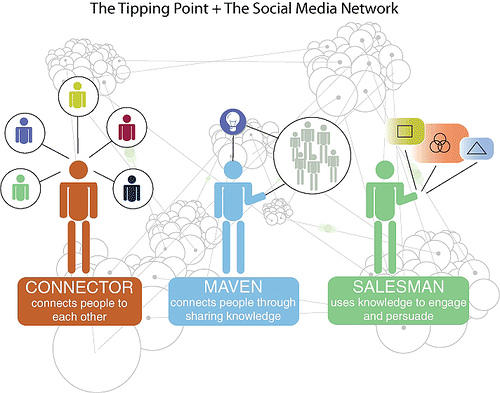
The Connector has several roles within my studies. Initially I would suggest that a Connector is someone with a significantly high number of Twitter and/or Facebook followers and someone who would ‘retweet’ another persons post as this is something of interest and wishes to pass this on to others. I would also propose that TV and Radio presenters connect people has people tune in and listen or watch as they maintain power and control over what is said when things are said and so on and so forth
The Maven in this instance could also be those with a large number of Twitter and/or Facebook followers and as people who connect with similar people of similar interests and share their knowledge with them all and each other
The Salesman is from one side is someone of power who has a significant amount of influence on people enabling them to persuade those who are listening or watching or reading. Such people again could be those with a large number of Twitter or Facebook followers, or a TV/Radio presenter who has a large number of listenings. It could even be a writer that has a good reputation.
In this diagram I would say that my role has the person who is creating and initiating the distribution of the words I would sit in the Saleman section as I build up my knowledge in this field I use that to engage and persuade people to take the word and adopt it and share it with others.
Influencer Analysis
- You influence someone about something.
- Someone becomes influential as soon as they are trusted by a sufficient number of good people.
- …social media is actually a gigantic network of networks of people with common interests (communities or tribes), in which content is exchanged, often as links, and where people interact with each other. It’s the ideal environment for spreading influence by hear-say.
- Keep in mind that influencers need to publicize their expertise through a quasi-continuous stream of content (influencers are media), and through repeated interactions with their peers (influencers are social).
- It is much easier to do it with others. You need to share, read, write and converse with others in order to reach this goal. This collaboration is organized at first around the experts of a given domain.
—-
Bibliography
http://www.kstoolkit.org/Social+Network+Analysis
Influencers and Community Marketing, Thoughts & Data by eCairn – The 2 Pillars of Influencer Analysis November 2, 2011
http://blog.ecairn.com/2011/11/02/the-2-pillars-of-influencer-analysis/
