The Open Brand 2008
When Push Comes to Pull in a Web-Made World
by Kelly Mooney and Nita Rollins, Ph.D.
New Riders: CA
“…for today’s consumers, community-by-brand-association is not enough. Now, before, during and after purchase, consumers are engaging directly with each other through blogs, ratings and reviews, tagging and other interactive forums. They’re sharing opinions, riffing off each other’s creativity and seizing control of the messages and values that brands once generated and propogated.” p18-19
“These peer-to-peer digital communications have begun to upstage brands as the gateway to covered membership in communities – however abstract or ephemeral. For brands to survive this relationship shift, this digital displacement, they need to engage the tribal tendencies online consumers on their own turf. Brands have to support those communities that have the closest affinity with them – and create some of their own.” p18-19
“For the last thirty years or so, brilliantly controlled brand management was the perfect approach for persuading a mass market…who willingly – even eagerly – put their faith in brands…While some of today’s top brands continue to succeed…-sealed off from rising consumer influence-it’s only a matter of time before chinks of cultural obsolescence appear in their armor. This will made brands vulnerable to waves of pressure…” p19
“The closed brand will be overwhelmed by passionate, powerful consumer who wants her brands open – or not at all.” p19
“1997…Burton Snowboards launched an online initiative to enable customers to upload and share photos and engage in threaded discussions…a powerful credibility booster for the brand.” p22-23
“Now all brands are expected to provide…opportunities for consumers to exchange ideas and be both seen and heard.” p23
“The open brand is an avid advocate of consumer participation – of leveraging the power of communities and networks – and enables the consumer to influence the brand and co-create its future.” p24
“The successful open brand will operate under a new set of assumptions, including that the consumer will gladly ask for what she wants, engage in an ongoing dialogue and frequently share her opinions about brands with the online public. And that the brand must engage the consumer through transparent commmunication, trust consumer to co-create the brand message and learn to be guided by impassionate amateurs.”
“A.G.Lafley, CEO of Proder and Gramble…Consumers are beginning in a very real sense to own our brands and participate in their creation. We need to learn to let go.” p24
On-Demand
“…they want it – and often get it – ‘right now’ – instant gratification.” p31
Personal
” – building relationships with constant consumer dialogue…bring the brand closer to each consumer’s real-time needs, want and expectations.” p33
Engaging
“Interactivity is key to deepening consumers’ emotional connection with a brand…” p35
“A well-designed website with interactive content can invite more consumer dialogue.” p38
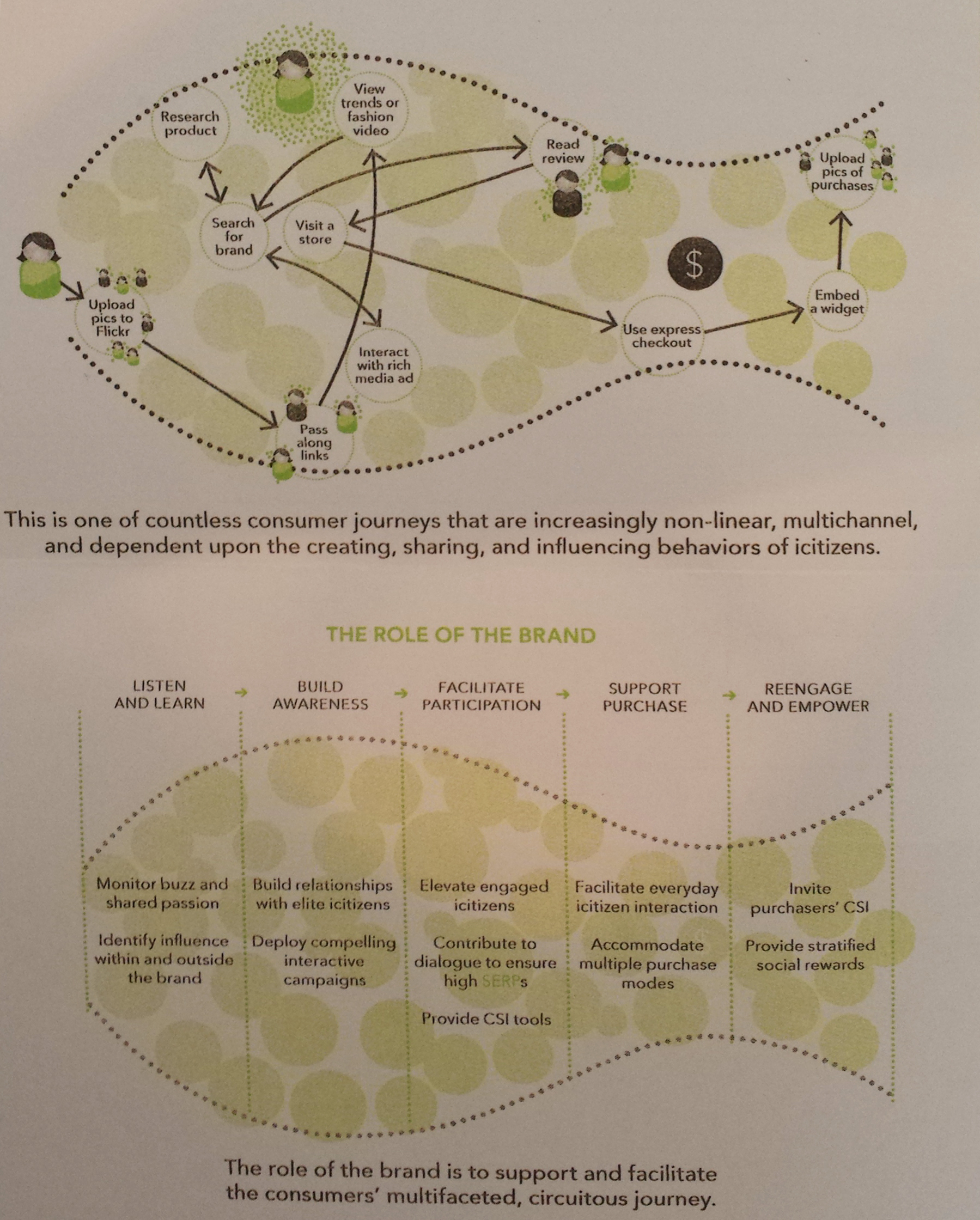
“Three revolutionary and related online behaviours…”
Creating
Sharing
Influencing – the ability to affect other people’s attitudes and actions
“”85-90 percent of online consumersacquire enough digital avvy – through searching, surfing, reading, etc. – to become reliable ‘experts’ to friends and family. They information they store, even within their relatively small spheres of influence, can significantly influence purchase decisions.” p55
Can I do something with this?
“What is beyond debate is this: the digital behaviours of creating, sharing and influencing have altered consumers’ expectations of brands.” p55
“The Resource Interactive 2007 iCitizen Motivational Study showed that 86% if the U.S. online population or roughly 200 million people (Internet Usage and World Population Statistics for June 30, 2007) are creating, sharing and influencing. p55
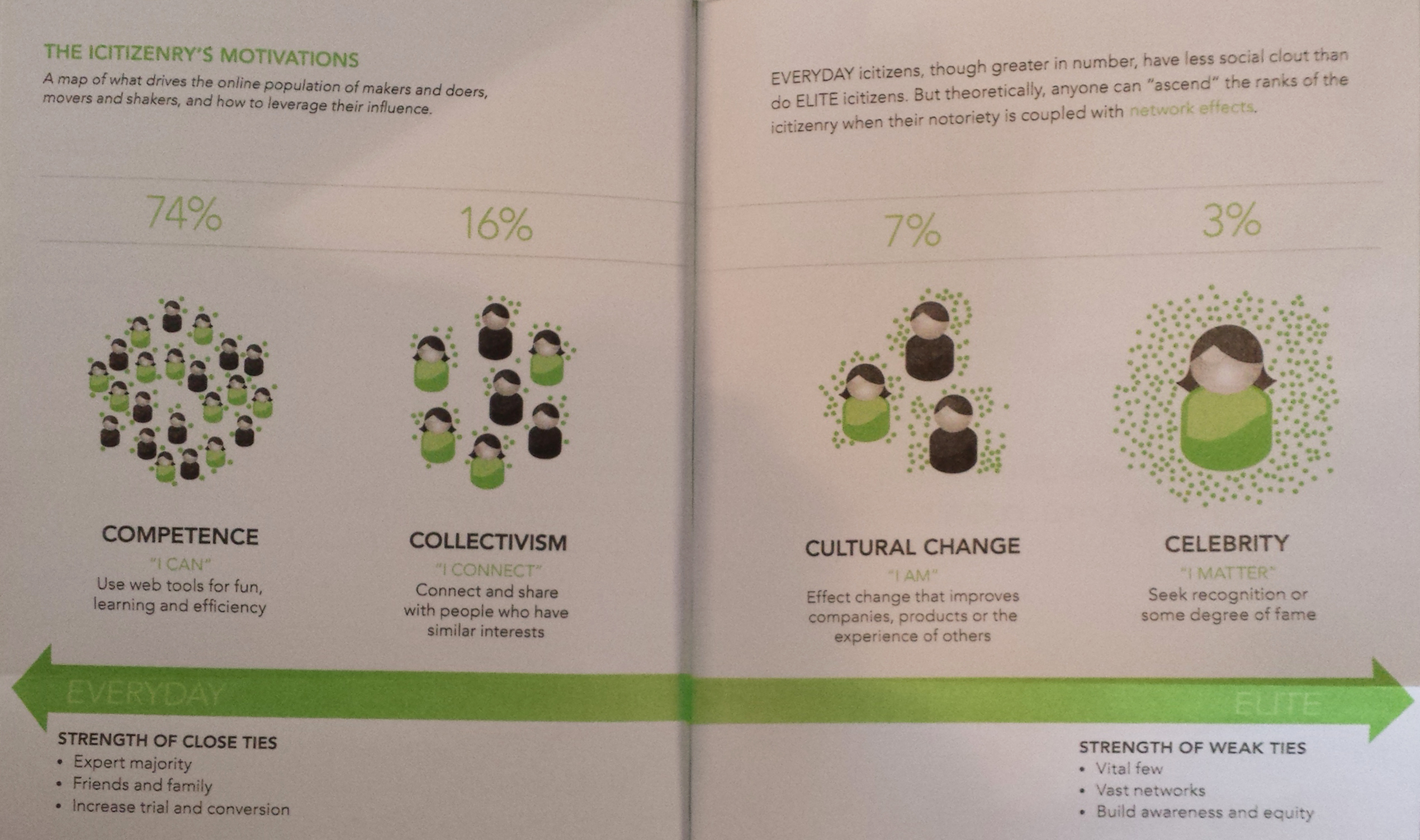
“…all icitizens are uniquely passionate and transparent about their expertise…Their notoriety achieves critical mass, and their influence gains momentum and reach in a way that is particular to the web.” p64
“…elite icitizens, whose more widespread influence reaches people not known to the cultural change – motivated or celebrity-seeking icitizen. Because of the trust and familiarity existing between everyday iCitizens and their close-knit networks, they are best leveraged for driving trial and purchase. Elite icitizens can be used to build awareness of a brand.” p64-65
“The growth of trust in a peer network is tied to waning trust in traditional cultural authorities and institutions – the Church and State, educators and, yes, brands and the mass media. Consumers are less trusting because they’re jaded by everything from lackluster customer service and brand blandness.” p81
“…52 percent of adult consumers typing queries into search engines are doin gso to make or influence routine purchase decisions.” p82
“All consumers are 50 percent more likely to be influenced by word-of-mouth recommendations from their peers than by radio or TV ads, according to a Nielson Buzzmetrics 2005 report. Why? Because trust is now in the network – in groups of interconnected ‘people like me.’ p82
“…opinions have more legitmacy if we believe they are based on personal experience or the desire to help others through sharing, rather than on the tactics of corporate persuasion…Those ‘boased’ opinions acquire even greater legitmacy if they’re grouped with other similar ones or constitute a rating system of popularity or reliability…trustworthiness…” p83
“…to make acceptable bias work in a brand’s favor is simple: enable and foster dialogue about your brand and products without seeming to influence, interfere with or manipulate it. Give iCitizens a forum, a gathering place, a community of their own.” p83