Psychological Aspects of Cyberspace. Theory, Research, Applications. 2008. Edited by Azy Barak. New York: Cambridge University Press
Trust. What is Trust?
“…trust is critical when there is a degree of uncertainty (Mayer, Davis and Schoorman, 1995). This uncertainty also needs to contain an element of risk (Deutsch, 1962). Without any risk, or vulnerability, there is no need for trust (Mayer et al., 1995).” p19
This statement is very important in my studies and something to consider and refer to as I continue through.
In this book they believe that three components are needed for trust to take heed. p19
“Ability – refers to the knowledge, skills, and competence of the person trusted to conduct the expected actions.”
Example: information can be taken without revealing it to all.
“Integrity – refers to the belief that the person or institution will act in an honest, reliable, and credible manner.”
“Benevolence – refers to ‘the extent to which a trustee is believed to intend doing good to the trustor.’ (Bhattacherjee, 2002. p219)”
—
Trust and the Internet
- Building Trust Online
“Researchers have found that on the Internet individuals go about reducing uncertainty by asking more direct, probing questions (Tidwell + Walther, 2002).” p21
“The use of profiles, and particularly photographs, is also designed to increase the level of trust at an interpersonal level (Tanis + Postmes, 2007; Whitty + Carr. 2006).” p21
“People also use linguistic cues to convey trustworthiness.” Galegher et al (1998) conducted some experiments to “…look for clues about how their members established legitimacy and credibility…They posted messages appropriate to the group, and use of snappy headers to make themselves ‘heard’…posters refer to their own membership of the…group, or how long they have lurked for before asking a question/replying to one.” p21
“Within pseudonymous environments, reputation systems also provide an important marker for trustworthiness (Resnick, Kuwabara, Zeckhauser, & Friedman, 2000)…Resnick and Zeckerhauser (2001) studied the eBay reputation system and reported back that feedback given did seem to predict the sellers’ future success, including the chances that their good would be bought.” p21
With my investigations last year and planned studies for this module as these systems have influence on actions of others can similar influencial components be used in the design to influence further?
“…reputation systems have spread, such that is now common to find community systems with rankings for members based on (amoung others) longevity, number of postings, and (for the highest ranks) a form of peer review. The ability to ‘Digg’ or ‘Bury’ stories acts as a form of community-derived trust building. Many of the blog commenting systems for reader rating comments, and the hiding of poorly ranked comments.” p21-22
“Another development has been the use of web-based seals, for example TRUSTe…These seals are a visible way to reassure customers that online businesses respect an individual’s privacy on the Internet and are designered to enable customers to ‘buy online with confidence’ (Trust UK).” p22
“Liu, Marchewka, Lu, and Yu (2005) fuond that the levels of trust can be increased by integrating a comprehensive privacy policy in to the desig of a…website…” p22
“However, much research (e.g. Tsai, Cranor. Acquisti, & Fong, 2006) has found that although the majority of users tend to notice the presence of privacy policies, they rarely read them.” p22
“…using a mock commercial website, Metzger (2006) found that it is the reputation of the company that is important in influencing trust and disclosure of personal information online, not privacy assurances.” p22
Opportunity – creation of a mock website to test from
“Boyd (2003) who hypothesizes that trust online is built through rhetorical devices such as providing descriptions of websites credentials and competencies, display customer feedback, records of past security performance, and offering simple and clear assessments of risk to potential customers.” p22
In addition to this I do believe that use of security symbols such as padlocks, and other security signs can be more than sufficient to build the trust for the user on their journey.
—
Measuring Trust
“Measures of trust tend to be specific to individual studies.” p23
“In the tradition sense, mediation refers to the effect of an independent variable on a dependent variable being explained by common links to a third variable. The reported results would therefore suggest that privacy has no direct effect on behavior; instead, any effect could be explained by the links between privacy and trust and between trust and behaviour.” p24
This third variable could be any of the components I found in the my analysis conducted in previous my previous study such as the use of emoticons, or friendly punctuation, or use of directive persuasive personalisation. Any of these could have an impact on the levels of trust that are transferred between individuals or institutions.
“There are a number of steps that can be taken to…enable the development of trust…” p25-26
“…trust needs to be built in to the design of Internet services, either through enabling of trust building activities or the use of trust cues and mechanisms.” p25-26
“…we have seen that trust can be encouraged by allowing users time to exchange soci-emotional messages, rather than forcing them to focus only on task-based communication.” p26
—
Influences on the Nature and Functioning of Online Groups by Karelyn Y. A. McKenna
“Spears et al (2002) have argued that anonymous communication within groups leads to a sense of depersonalisation by the group members…when members feel an absence of personal accountability and personal identity then the group-level becomes more important…The degree to which the group identity is salient, however, plays an important role in determining what the effects of anonymity will be on the development and influence of group norms.” p235
“An intermediate level of conformity to group norms was evinced whether group salience was high or low for those participants who interacted under individual conditions.” p236
—
“Many other websites, particularly many user forums, news sites, and music sites, begin to display statistics on certain user behaviors (‘This story has been read 268 times’) or even dynamically adjust their layout by reserving certain attractive spots for frequently viewed, commented, downloaded, or linked items.” p274-275
————
Truth, Lies and Trust on the Internet by Monica T. Whitty and Adam N. Joinson 2009: Routledge: UK
Considerations:
- Effects on influence with or without rich media ie., pictures, audio or video (live streaming) p20
- Positive and negative socio-emotional messages p21
- Aggressive communication in online environments – ‘flaming’ or trolls p22
“…trust has a number of dimensions, including the competence, reputation and intentions (benevolent or malevolent) of the research organisation. People’s initial interpretation of the trustworthiness of a website tends to be made very quickly using design-based heuristics (Sillence et all, 2006), including inappropriate name for the website, a messy layout and the inclusion of adverts (Sillence et al, 2006).” p47-48
“Johnson et al (in press) compared self-disclosure to trustworthy and untrustworthy site. The untrustworthy site was hosted on a fake domain (www.surveylance.net) and included adverts, spelling mistakes and HTML coding errors. Perhaps not surprisingly, self-disclosure was significantly higher to the trustworthy questionnaire.” p48
“Fox and Schwartz (2002)…Control was introduced into the procedure by allowing participants choice as to the type of questions they wanted to answer, allowing movement through the questions to change or check their responses and providing sample questions to inform their choice. Participants given increased control also rated the test more positively than those with no control. They had more trust in the research, were less anxious and said that they were likely to respond with more candour…In the condition with weakened control – where participants were given a short time to answer each question, and could not move back to previous items – impression management was reduced.” p49
Ethical considerations from offline that can be considered online (p49-50) could be:
-informed consent
-withdrawal consent
-confidentiality
-debriefing
“…given the need to establish trust, it would seem that organisations with an existing reputation are at an advantage…increased size and reputation led to higher trust, which in turn influenced the perception of risk and the willingness to buy.” p105
How people assess trust in sites…p105-106
“Sillence et al (2006) argue for a three stage model for understanding how people access the trustworthiness of a website. Stage one assumes that people are faced with a number of potential websites, and thus engage in a rapid, heuristic-based analysis on the design of the site rather than the content. At the second stage, people engage in a more systematic analysis of the content of the site, during which time they are influenced by the apparent integrity, benevolence and expertise demonstrated (Bhattacherjee, 2002). Stage three is a relationship development and integration stage: that is, a person’s continued use of a site, personalisation and integration of experience.”
“A critical part of the first stage of assessing trustworthiness relies on the design of the website (Sillence et al 2006).” p106
“Lindgaard et al (2006) found that people can judge the visual attractiveness of a website in 50 milliseconds.” p106
“There has been a number of studies that have identified the critical design elements during this early stage (e.g. Briggs etc all. 2002; Egger. 2000; Fogg et al. 2001; Stanford et al. 2002; Wang and Emurian 2005). Some of the elements found in trustworthy sites are summarised in the following table…”
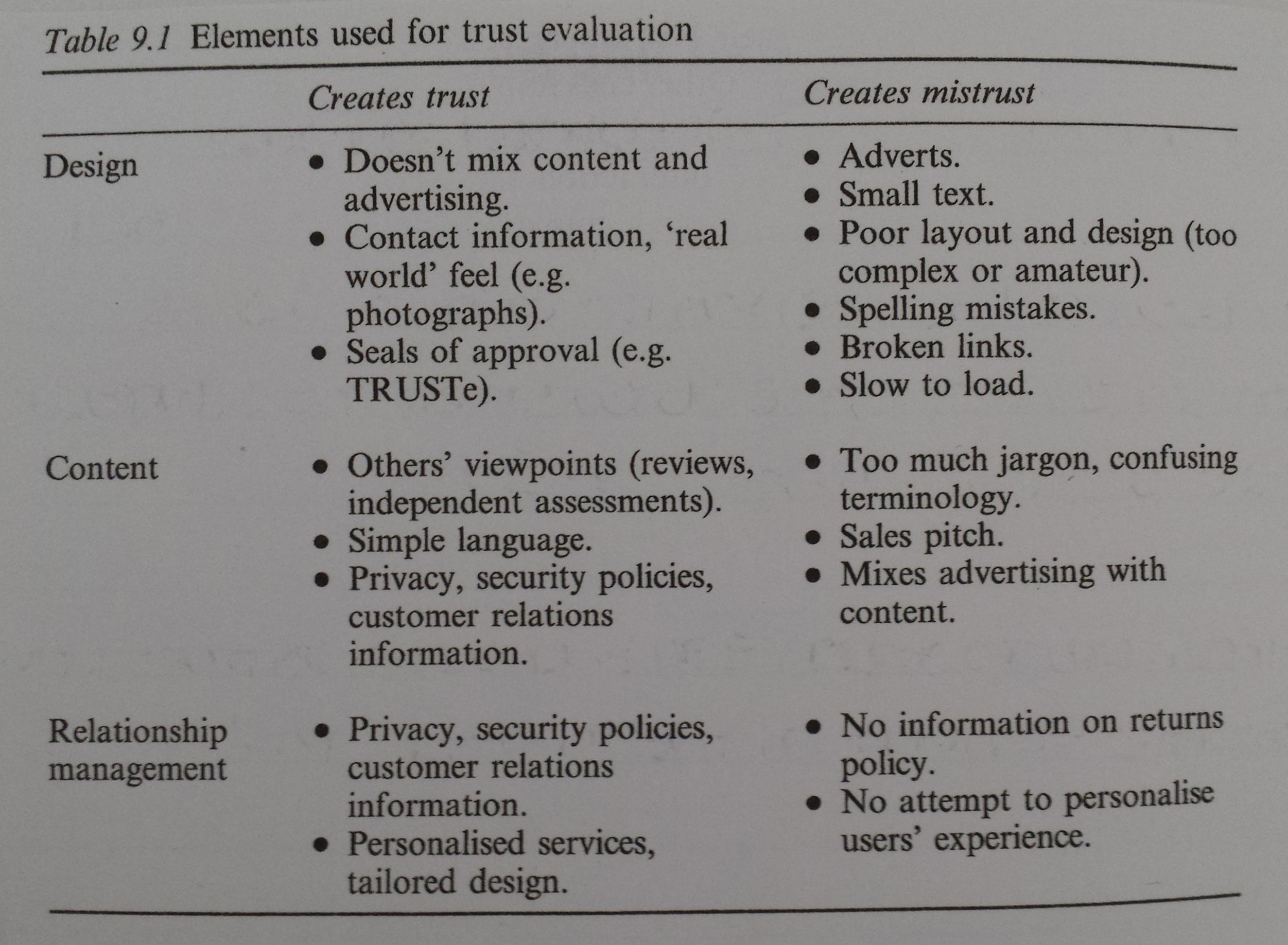
“…the impact of trust ‘seals’ (for instance, TRUSTe) is uncertain, with some studies finding them to be ineffective (e.g. Nielson et al, 2000). Similarly, the impact of photographs on websites has found to have both a positive impact on trust (Fogg et al, 2001; Nielson et al. 2000) and also neutral or negative impact (Rielgelsberger and Slasse 2001).” p106
“Stanford et al (2002) reported that experts assessed websites using reputation and their analysis of the information quality, while consumers were more swayed by the attractiveness of the website design.” p106
Interesting concluding thoughts for this book were as follows:
“The critical question facing those who design Internet Services is whether or not trust can be designed into systems without losing the benefits of privacy and freedom of expression provided by anonymous and pseudononymous environments. Perhaps first it is important to recognise that in many circumstances trust does not require touch, but it does require time. Studies of computer mediated communication that place strangers in new situations in order to study trust are found to fail if time is not allowed for ‘off-message’ activities that build trust…However we can shorten the process by designing systems that allow us to use other people’s trust experiences as a proxy for our own experiences…Trust cues – for instance, to competence or integrity – can also be designed into websites.” p144
As I have highlighted this point is exactly what I would like to investigate in my studies.
