Persuasion in the Media Age. 2nd Edition. By Timothy A. Borchers. 2005, 2002. McGraw-Hill: NY
“Blogging is a new form of persuasive communication that is significant for several reasons…gives considerable power to single individuals. Bloggers are able to easily write about their experiences while commanding an international audience of readers.” p4
“…blogging suggests that the INternet has emerged as a persuasive medium which has international access and appeal.” p4
effective means = famous people, humour, when and where
“Humour is an effective tool to help audiences remember a persuasive message.” p5
“…in today’s world, the media serve as intermediaries…coming between audiences and persuaders.” p6
“…someone is almost always trying to persuade us to believe something different or behave in a certain way.” p6
With this in mind how can we take back that control and use media to our advantage as designers to manipulate how people behave on the Internet?
“…the Internet will forever change those who use it.” p11
“Price and Price (2002) explain that hypermedia fundamentally change the relationship between persuader and audience members.” p11
Hypermedia = ie., video, sound, image etc
“With hypermedia, there is no longer one persuader who provides information to a mass audience. Instead, ‘many individuals exchange information with each other, aided by some people who do more writing than others.’p4 “p11
“The creator of a website, for instance, does not usually know how users will travel through the site. Users have a great deal of discretion in determining the length of time they spend on a page and what page they look at next…users, or audience members, have a great deal of power to manipulate and control the communication setting.” p11
I disagree with this. I believe the the ‘creator’ in my studies this would be the designer, can have the power to control the user and persuade them down a particular path through methods of trust, influence and persuasion. My studies are investigating this further. Although the viewer/user have a greater deal of control I believe with better understanding of tools to the the designers disposal it is about the positioning of content on the page that can determine actions of others.
“…allowing viewers to email their questions to the show…they become participants, influencing the questions that are asked and the direction of the discussion.” p12
For this book the definition of persuasion is based upon Burke’s Theory, “the use of symbols, by one symbol – using entity to introduce action in another.”;
“Persuasion is the coproduction of meaning that results when an individual or group of individuals uses language strategies and/or other images (such as images, music, or sounds) to make audiences identify with that individual or group.” p17
This definition refers to the methods used however I would extend this to elaborate on persuasion more defining it as a form of changing a persons’ behaviour deliberately through such mentioned methods, this is therefore seen as manipulative due to its abilities to sway opinions of others. Due to the deliberate approach of this method this can be seem as only temporary and not a preferred option to be adopted.
The question then lies of how influence is used following on from my definition of it being a more powerful source which acts silently with little to no effort needing to be made. This method is based predominantly on credibility and trust, trust which I shall investigate further in my research.
“…persuasion is a process instead of a simple one-way tranformation. Persuaders create messages…but persuasive process is incomplete until the audience becomes involved.” p17
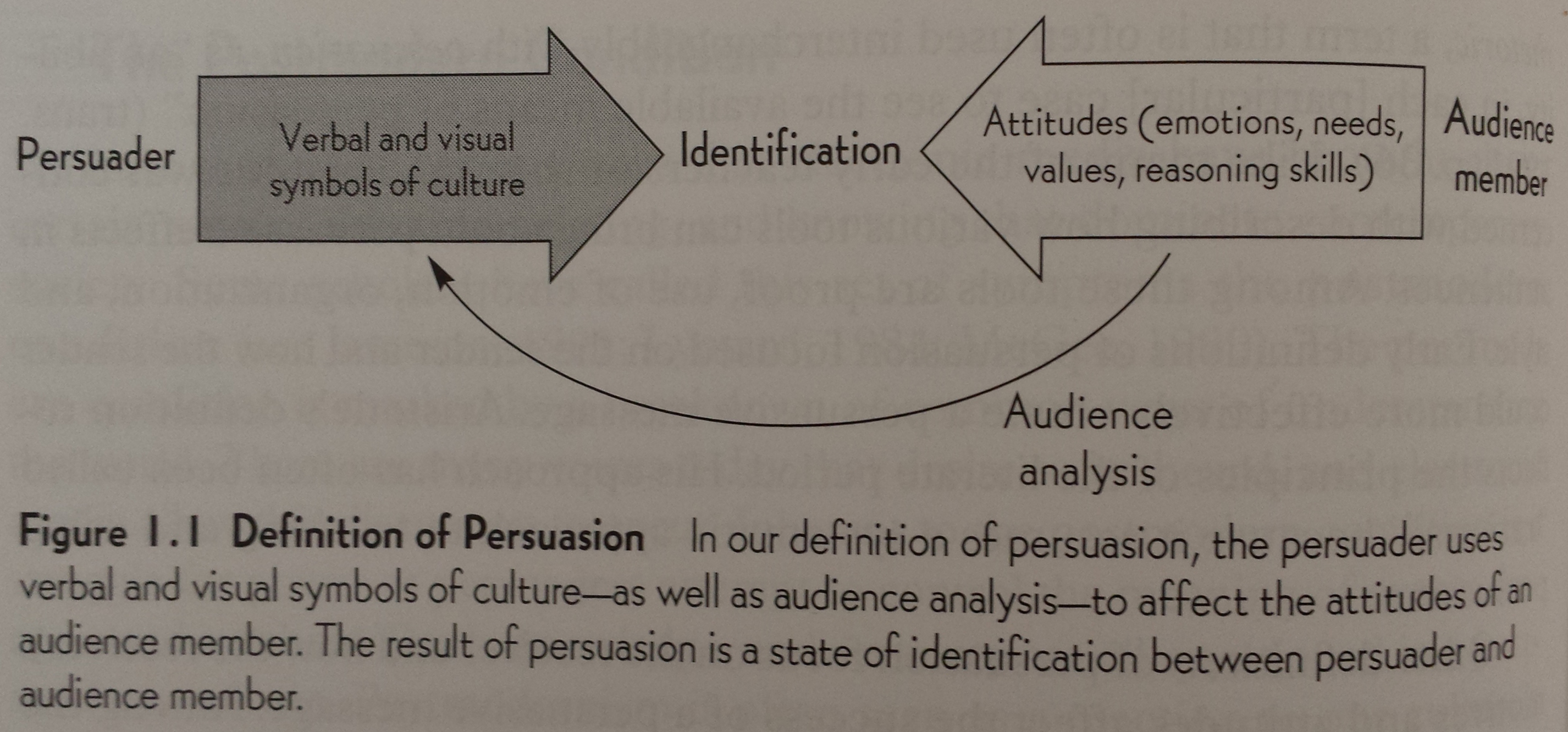
Persuasion is audience orientated.
“The source (or persuader) does not necessarily have an authority position. The source uses language strategies and visual images to suggest meaning to an audience, but the audience, using its own attitudes and reasoning skills, constructs its own meaning.” p22
“…the website’s creator often loses control when the site provides interactive elemments such as search devices.” p22
My studies will investigate if this is the case and if this can be changed.
—
Methods of persuasion for the persuader
An example of persuasion was with Pepsi Twist advert whereby they did not mention anything about the taste and instead played on featuring The Osbournes to ‘persuade’ the consumer to purchase this product
Can the use of familiar faces help with the building of trust and therefore influence?
“…using sophisticated tools of audience analysis. By understanding their audiences, persuaders can attempt to influence how those audiences identify with them. Yet there is no guarantee that persuaders will succeed in doing this.” p22
In the previous module I spent some significant amount of time understanding the audience of review systems in the hope to create a system to persuade.
“…persuaders think that we will be more likely to identify with them if we encounter them more frequently.” p26
“Persuasion today is often invisible” p28. My argument here would be that surely this would therefore be influence rather than persuasion where little to no effort is required to control the action of others on the Web?
Aristotle believed that the use of proof can persuade audiences. p37
-images represent reality, therefore images serve as proof for persuaders’ messages.
