Following our first presentation on our research so far I thought I would write it up and the feedback and next steps that came from it. So here goes:
To understand how I approached my research I have begun by showing how and where it all began. The many questions I had my time in the industry, and to compliment this slide one that shows examples of websites I have worked on…to highlight the areas of debate and discussions.

- Who uses the internet/web?
- Can one image depicted in various ways evoke different emotions/views
- Can I influence peoples decisions/predict peoples
- Responses/emotions/thoughts/actions?
- How influential is the web?
Many areas of interest and research for me are copying, facial recognition, influence, illusory contours, trust, security, and so on and so forth.
An interesting statement I found which really sums up what I am wanting to look at is, “When you break it down, web design is simply the manipulation of content and images on a website to appeal to the perceptions of a target audience.”
The following slide shows examples of websites I have worked on all of which at some point many questions arise which we really do not know the actual answers are but we just do what we ‘think’ is right.
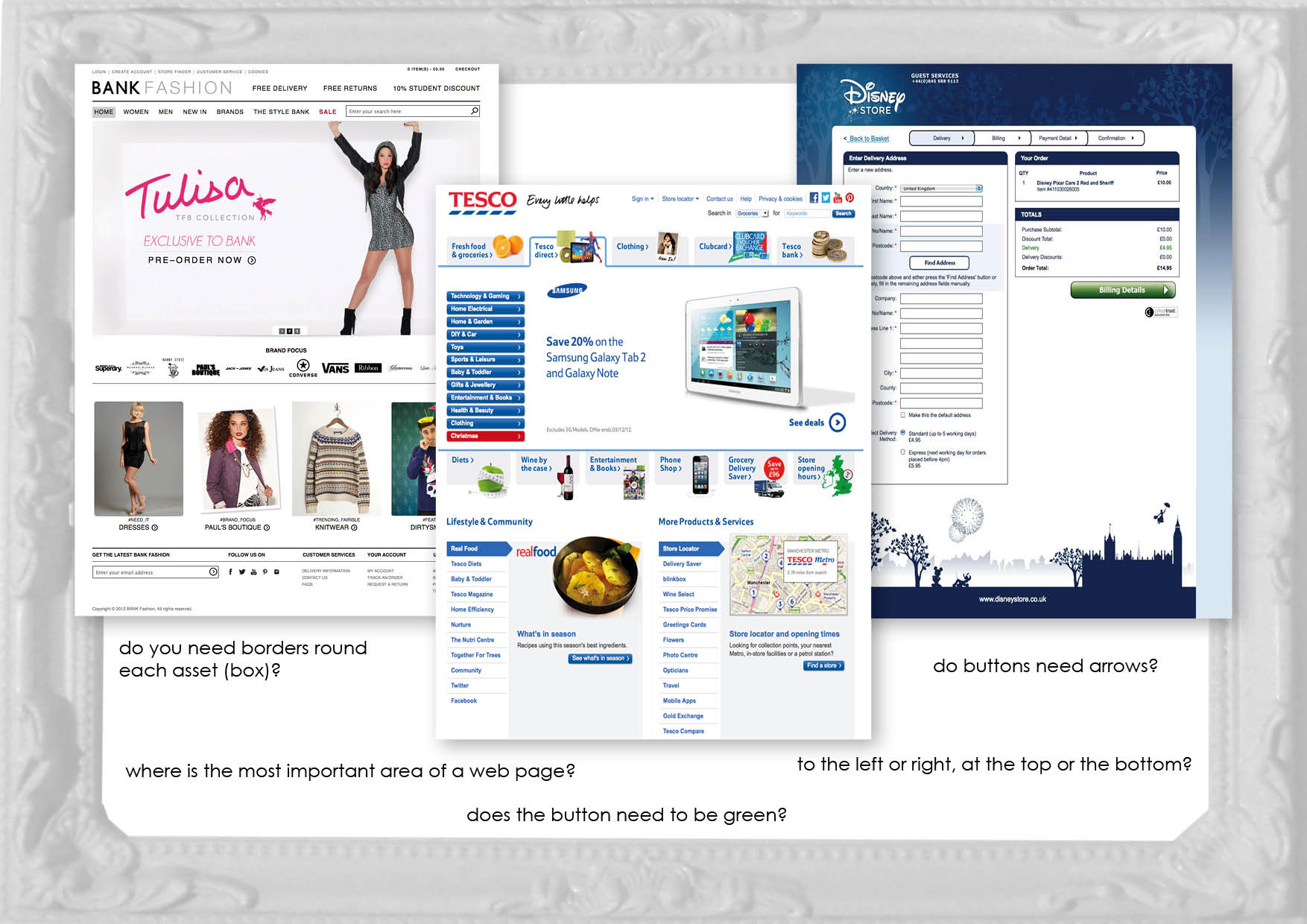
- Do you need borders round each asset (box)?
- Where is the most important area of a web page?
- Does the button need to be green?
- To the left or right, at the top or the bottom?
- Do buttons need arrows?
This brought me to the following slide which shows the question. How can the design/aspects of design of the web influence and create trust for the audience who use it?
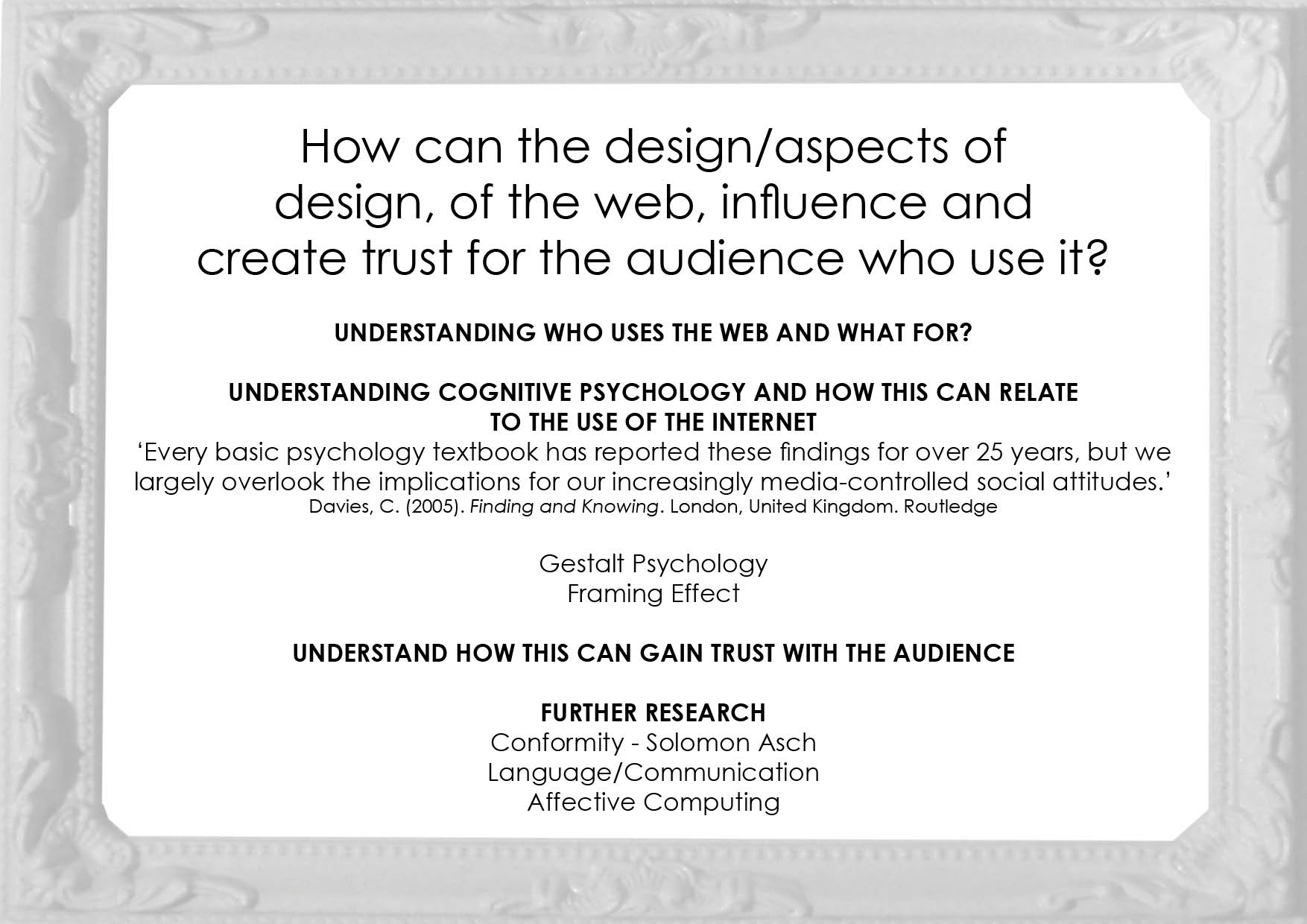
To help me conduct my research I then broke down the question in to areas to study:
- Understand who uses the web and what for?
- Understand cognitive psychology and how this can relate to the use of the internet
One of the quotes from Clare Davies in Finding and Knowing, that I found whilst doing my research which really sums up what I want to research is, “Every basic psychology textbook has reported these findings for over 25 years, but we largely overlook the implications for our increasingly media-controlled social attitudes.” This is exactly the reasons why I want to look at this area.
So from this I begin the search.
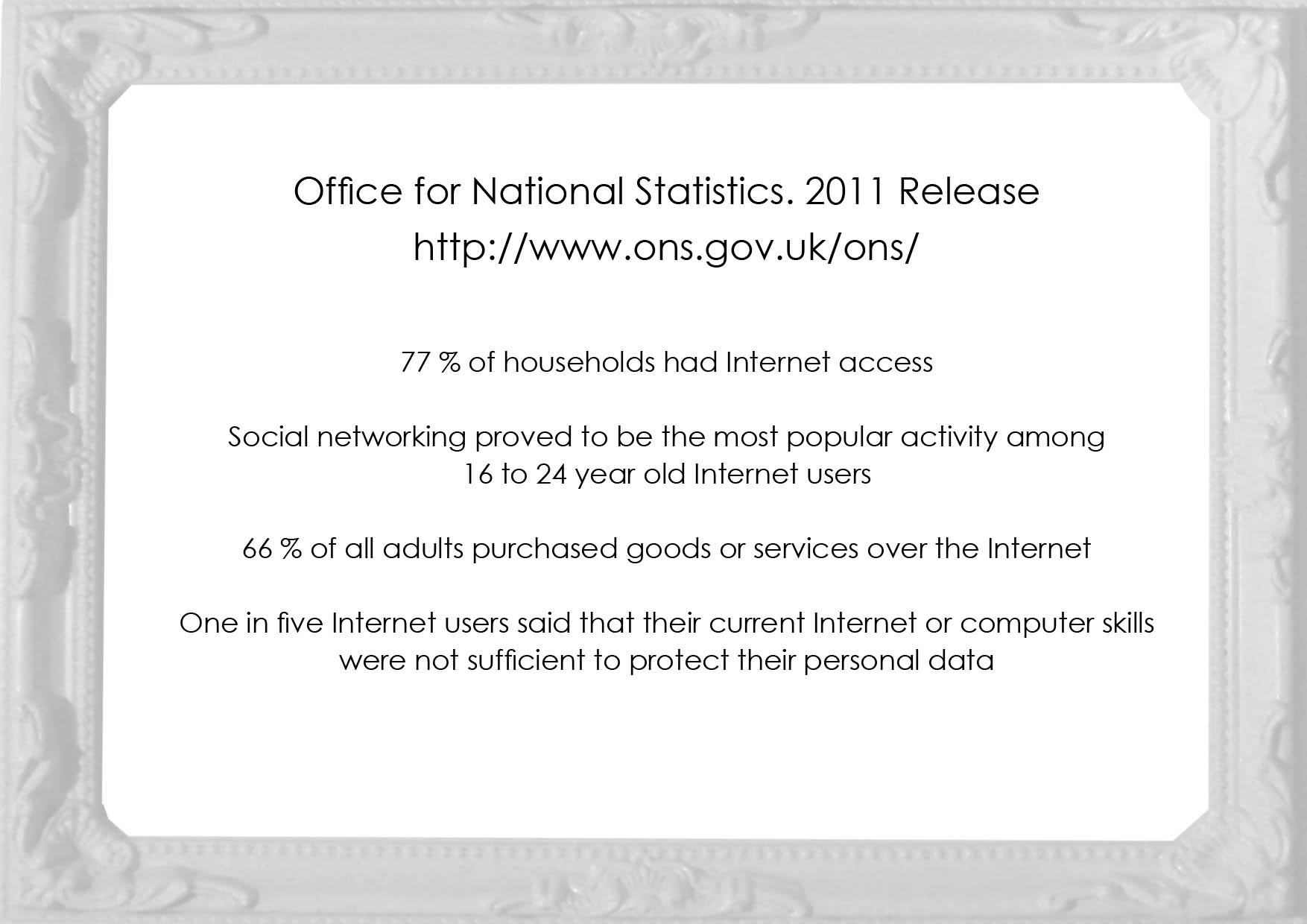
The following slide shows the statistics of the internet. Nothing here is of a great surprise really, its to be expected that the greated use is between 16-25 years and the less being of those 75 years plus. One fact that was of interest and plays a significant factor in the trust element of my topic is:
“One in five Internet users said that their current Internet or computer skills were not sufficient to protect their personal data”
One of the very first readings I did on starting the course I found really had many key elements relevant to my practise. Here I have highlighted this reading:
Mirzoeff, N. (1999) Introduction. What is visual culture? An Introduction to Visual Culture (pp 1 – 9). Oxon, United Kingdom: Routledge.
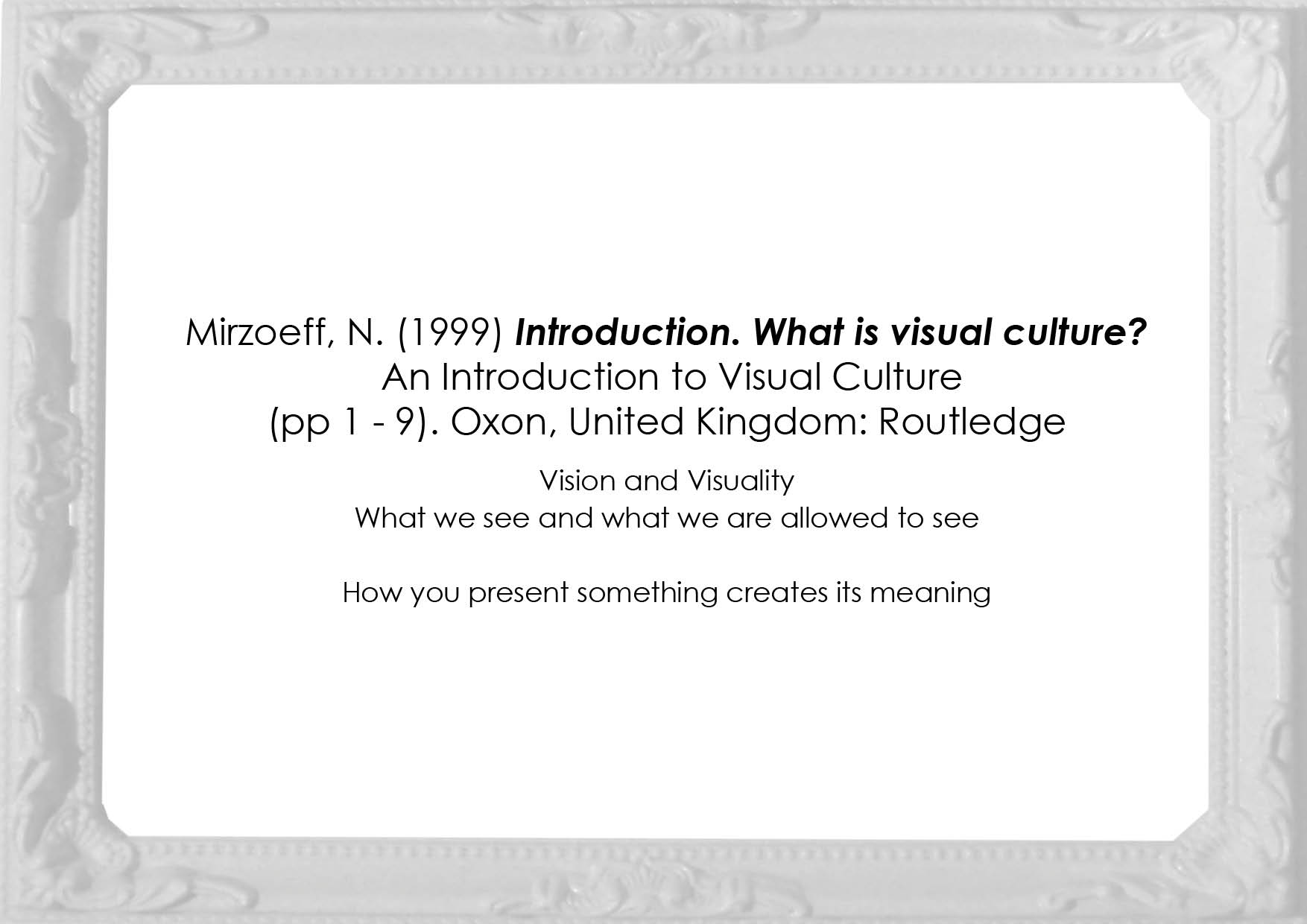
The element in this reading is the part discussing Vision and Visuality, what we see and what we are allowed to see by how things are presented to us causing up to form an opinion. How something is presented creates that meaning and this is true in some many things in life and very much so to how websites are designed.
The next slide is the person who at present I would say is certainly a key psychologist for the work I am looking at. Susan Weinschenk is a leading psychology who specialises in the psychology of technology. One of her key books is:
Weinschenk, S. M. (2011). 100 Things Every Designer Needs to Know About People. California, United States of America:
Pearson Education
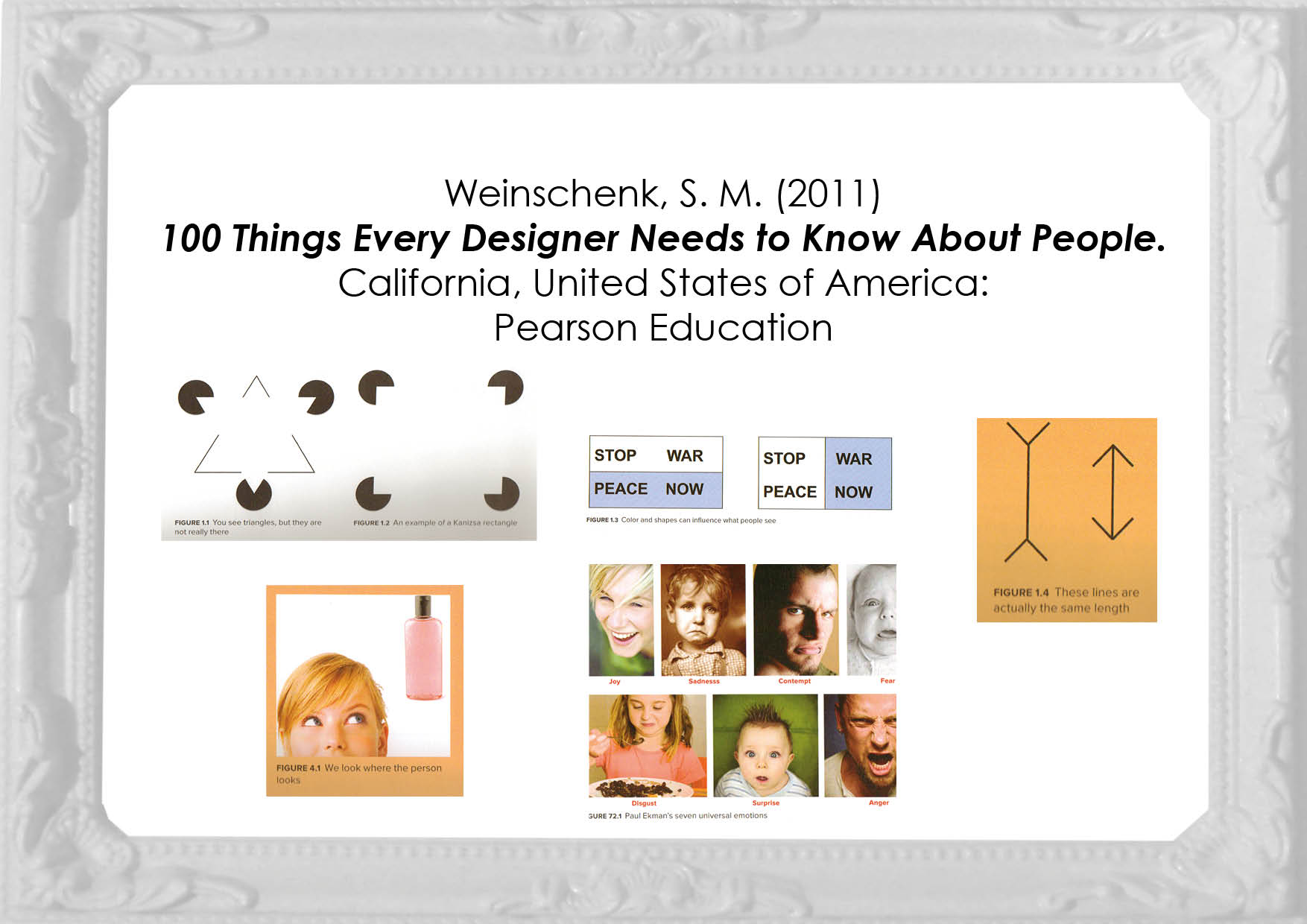
She looks very closely at the elements highlighted in the first slide drawing on the cognitive psychology and applying past experiments to the internet trying to understand how the audience think. She also looks at a theory known as Gestalt Psychology, the use of illusory contours and how this is applied to the design of the web.

The above slide are just a selection of the experiements she highlights in her books.
Gestalt Psychology and the Kanizsa Triangle which creates illusions and shows how your brains completes missing areas create, as in this example, a shape that isn’t there.
STOP WAR STOP PEACE
This example shows how slight changes of how text is laid out and position can create completely different messages.
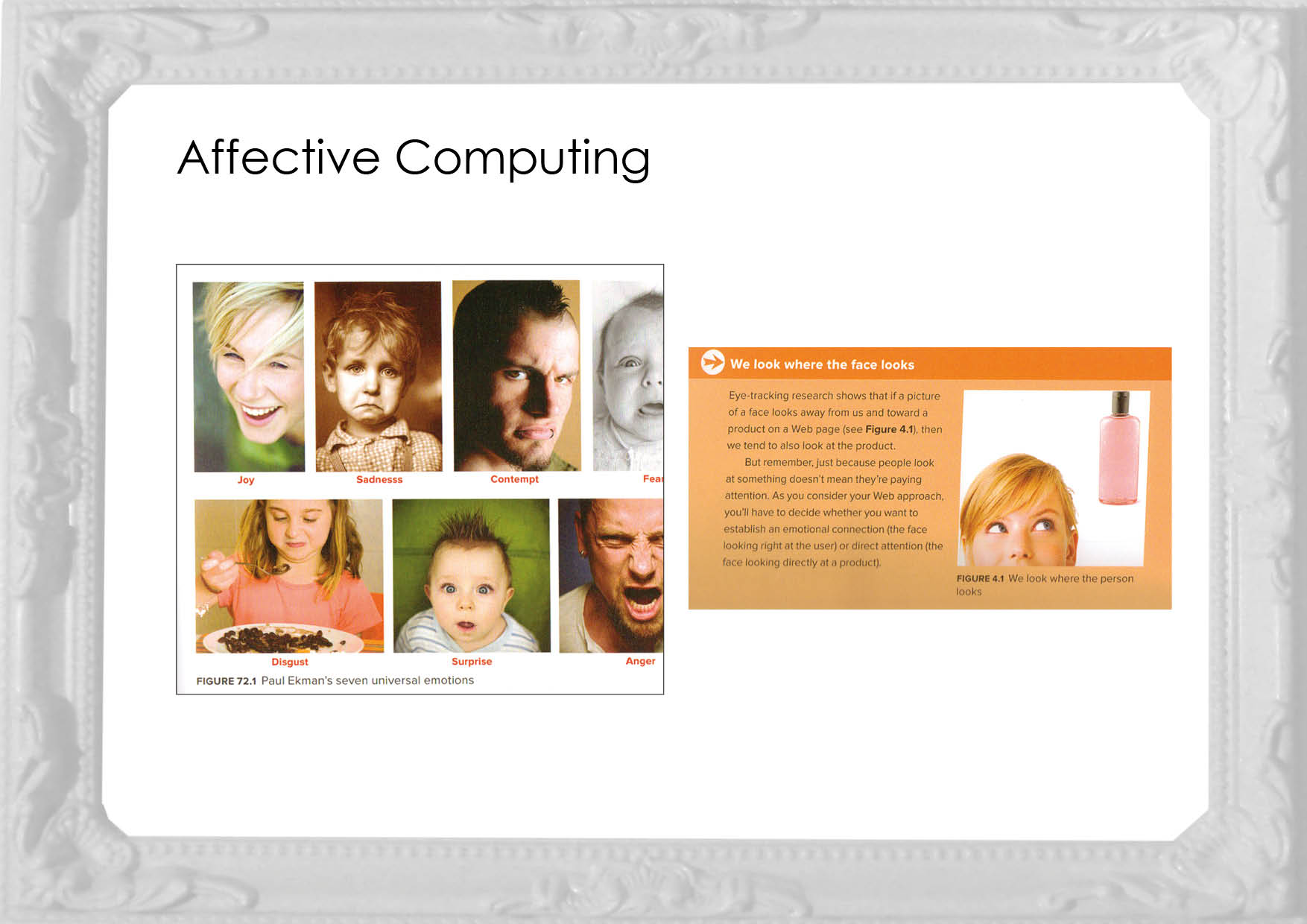
The image showing a lady looking up to a product indicates how facial recognition and eye tracking can playing a key part to leading you round a website which even thinking about it.
And the panel of faces which all sorts of expressions is a experiment from Paul Ekman looking at how people respond and recognition expressions and how this can evoke emotions and opinions to the on looker.
The following slide are a couple of journals. One looking at Influences of online store perception, shopping enjoyment, and shopping involvement on consumer patronage behavior and the other How do storefront window displays influence entering decisions of clothing stores. Both these readings are of great insight, and the one to highlight is the attention of the store windows. A lot of time website pages are seen as store windows as the impression gained here is what determines if the person pays a visit to your website/store. These are arguably the most important aspects of the site…the length of time you have to get hold of the onlooker however differs somewhat to the landing page of a site which is of significant less than that of a shop window whereby you may have a bit longer.
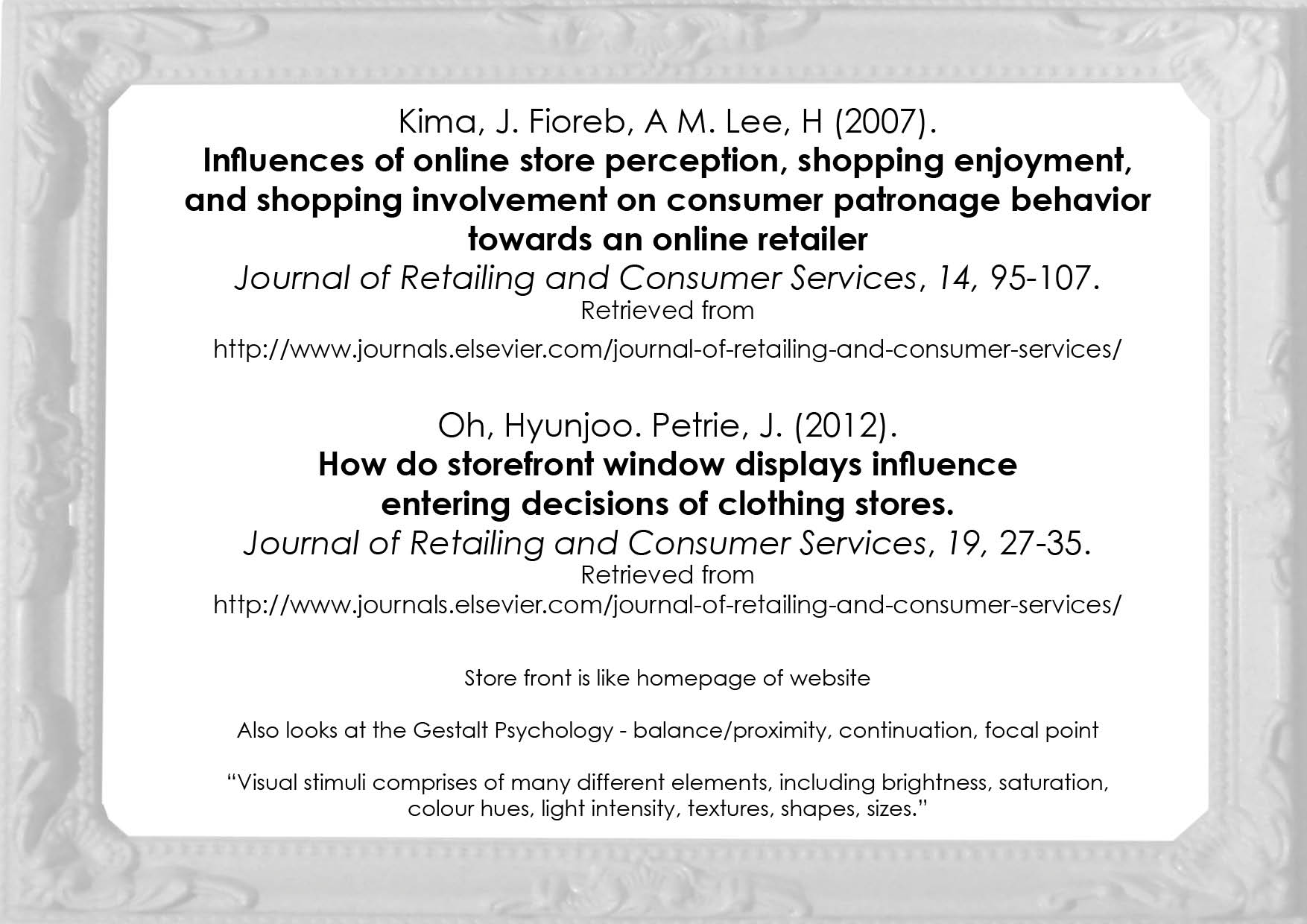
Here there is a clear reference again to the Gestalt Psychology, understanding that a lot of it is to do with balance/proximity, continuation and the focal point. And this is stretch across from store window to online. Each need to take the visual stimuli in to account looking at colour, shapes, sizes and so on and so forth.
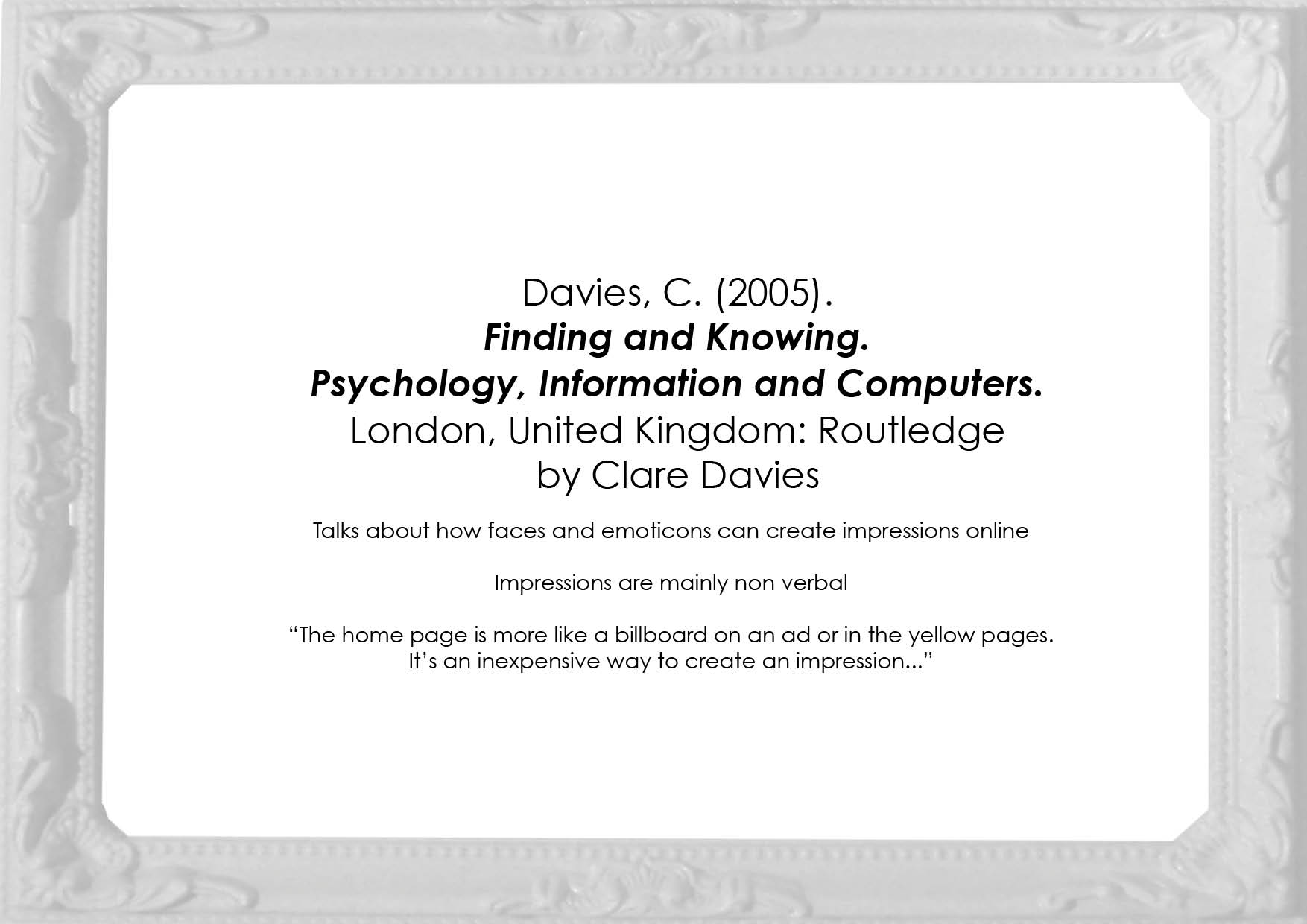
This book above, Davies, C. (2005). Finding and Knowing. Psychology, Information and Computers. London, United Kingdom: Routledge by Clare Davies, has some great pointers more focused on impressions online and how this is usually formed non-verbally online. Davies states, “The home page is more like a billboard on an ad or in the yellow pages.
It’s an inexpensive way to create an impression…” And with the journal reading in mind, online we have the attention of the onlooker for only a short period of time. So its how can we make that impression and hence impact strong to entice them to stay for longer!?
Looking more closely to the cognitive theories that interest me I am drawn to the Gestalt Theory.
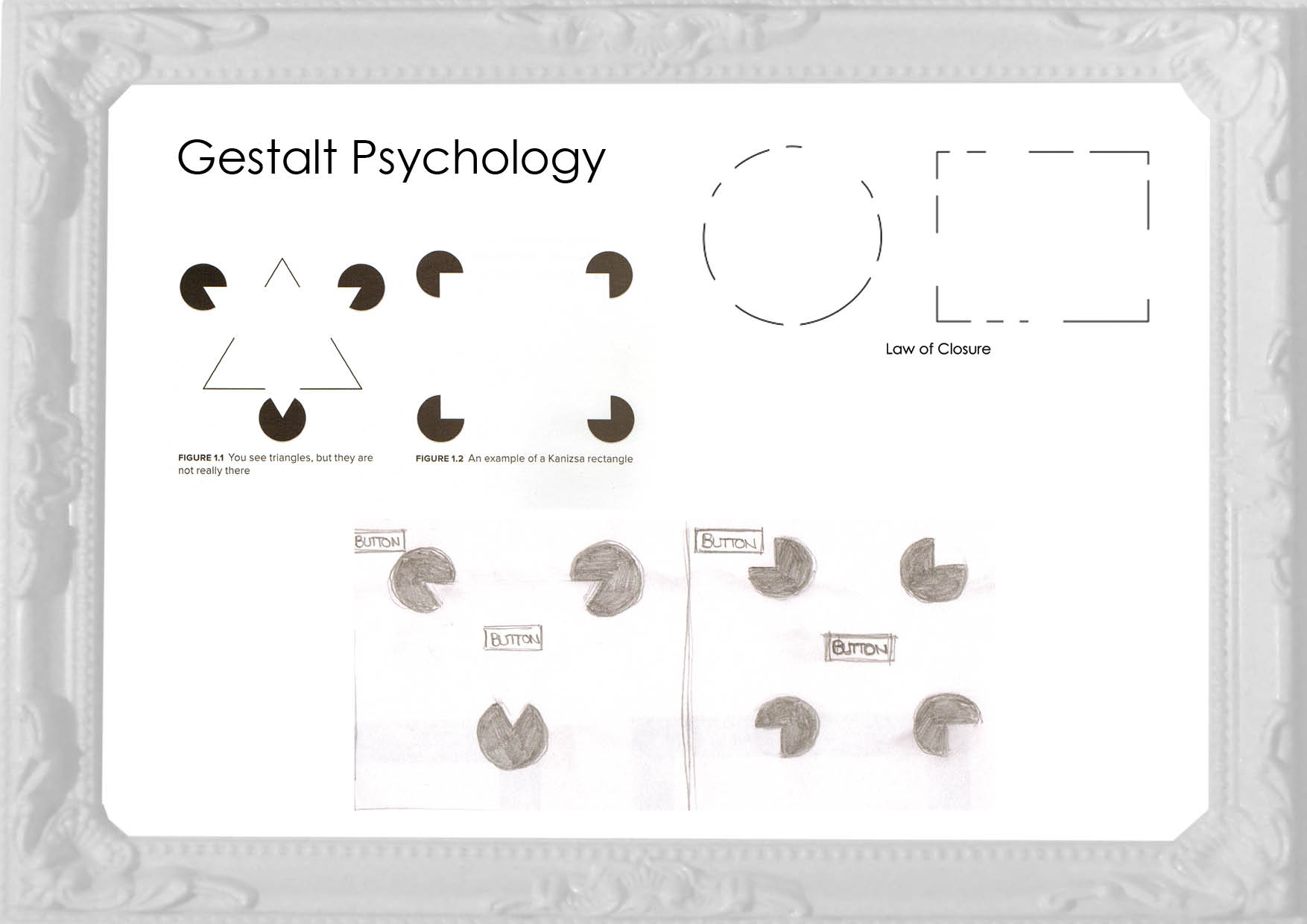
This theory has been mentioned in a few of my readings and it seems this is a solid practise used in the design, and decisions of the web. Its key for looking at its Law of Proximity and Similarity. This can guide such things as placement of buttons…or other important elements.
Another key area highlight right at the start of the MA when reading about Vision and Visuality. This is The Framing Effect.
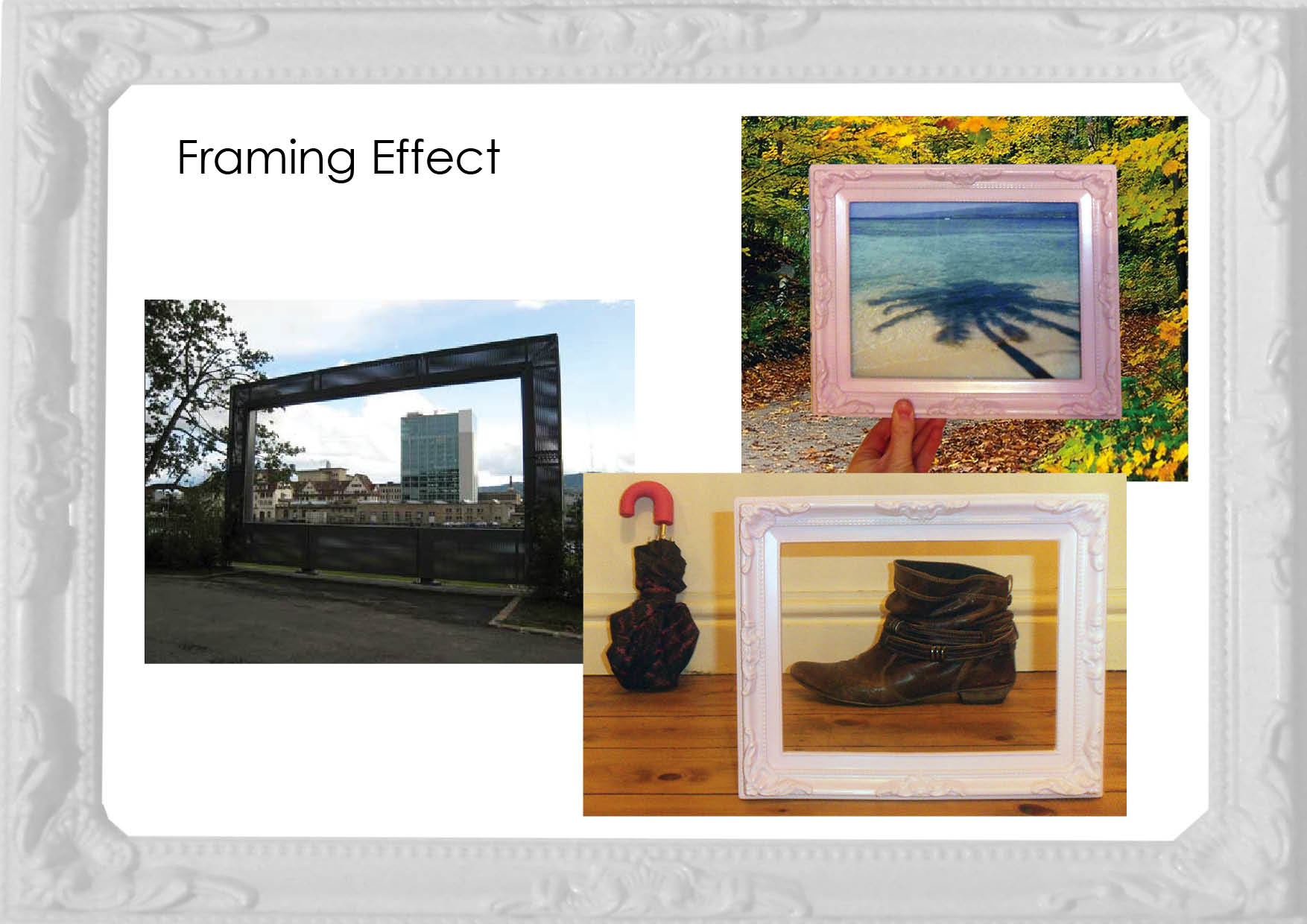
The Framing Effect is a study founded by two psychologists Amos Tversky and Daniel Kahnman (1981). They look in to how people react differently to a particular choice depending whether it is presented as a loss or a gain. They further looked at how the framing effect can affect the outcome choices we make.
The the last two slides highlights the keys areas at present. However as my research has continued I have been aware of areas of additional research that I want to highlight but not draw on to long. I wish to take it and box it for the mean time, with a wish to draw on it at a later stage when I am gathering my findings of all these elements of the web.
The further research focuses on conformity.
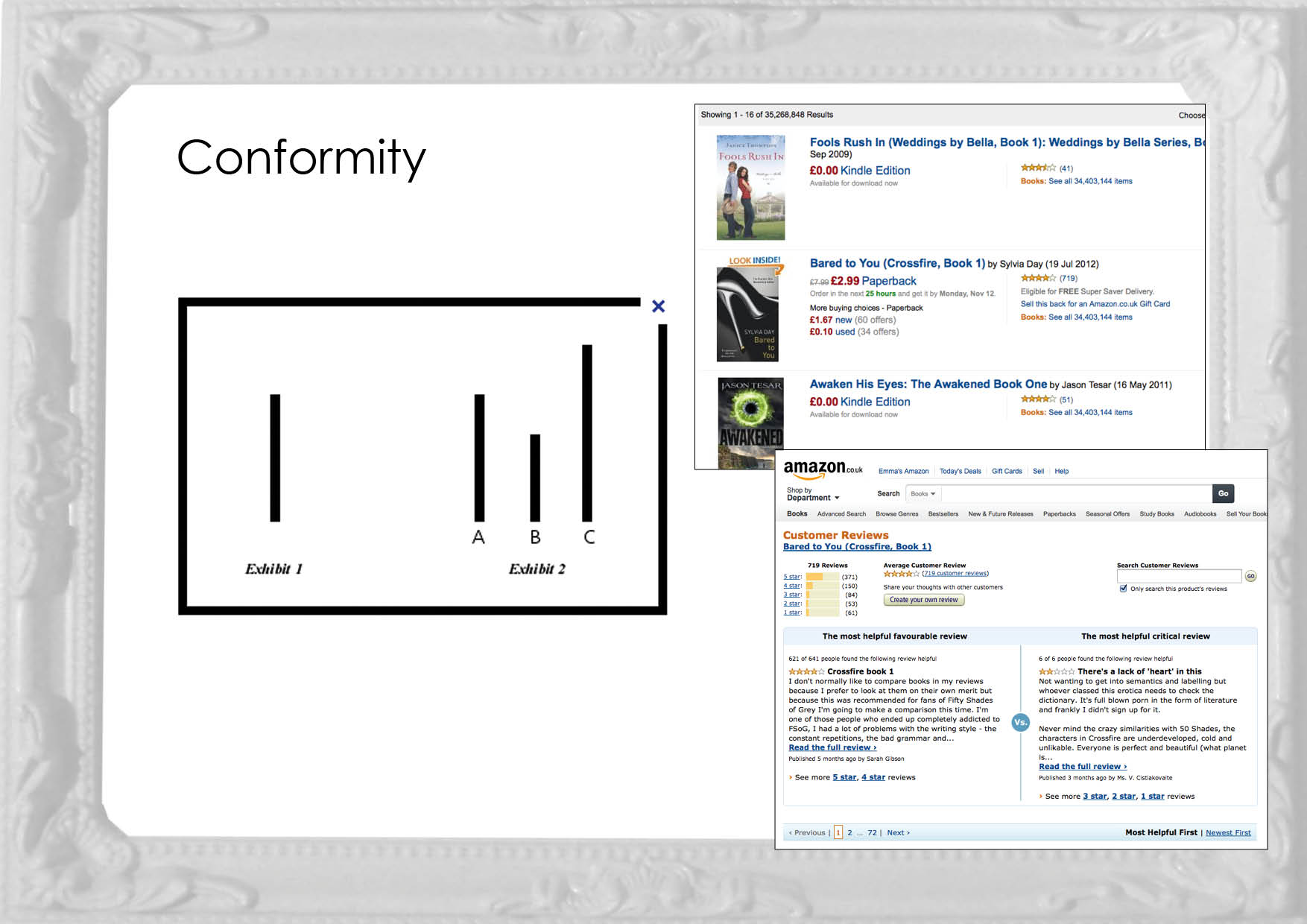
Conformity is huge in the world of the internet. Solomon Asch is a wellknown psychologist who has done a test whereby a control is presented as an answer, the wrong answer to a selection of lines. He wants to see here how many people will conform with this control even if they think another is the right answer. This is true to today with the fast growing awareness of reviews, be it on products or books, there is a clear uptake on interest if the review is really good…and this is simply represented by a 5 star scoring system, with little to no interest being shown if reviews are poor.
Language and communcation is massive to get across a message in a certain way to the audience of that site. Despite being restricted to the QWERTY keyboard to communicate many new ways are being founded all the time with the use of caplock for SHOUTING and the use of emoticons to express oneself emotion to the person you intend  Then there is the abbreviation for the busy people in us BRB!
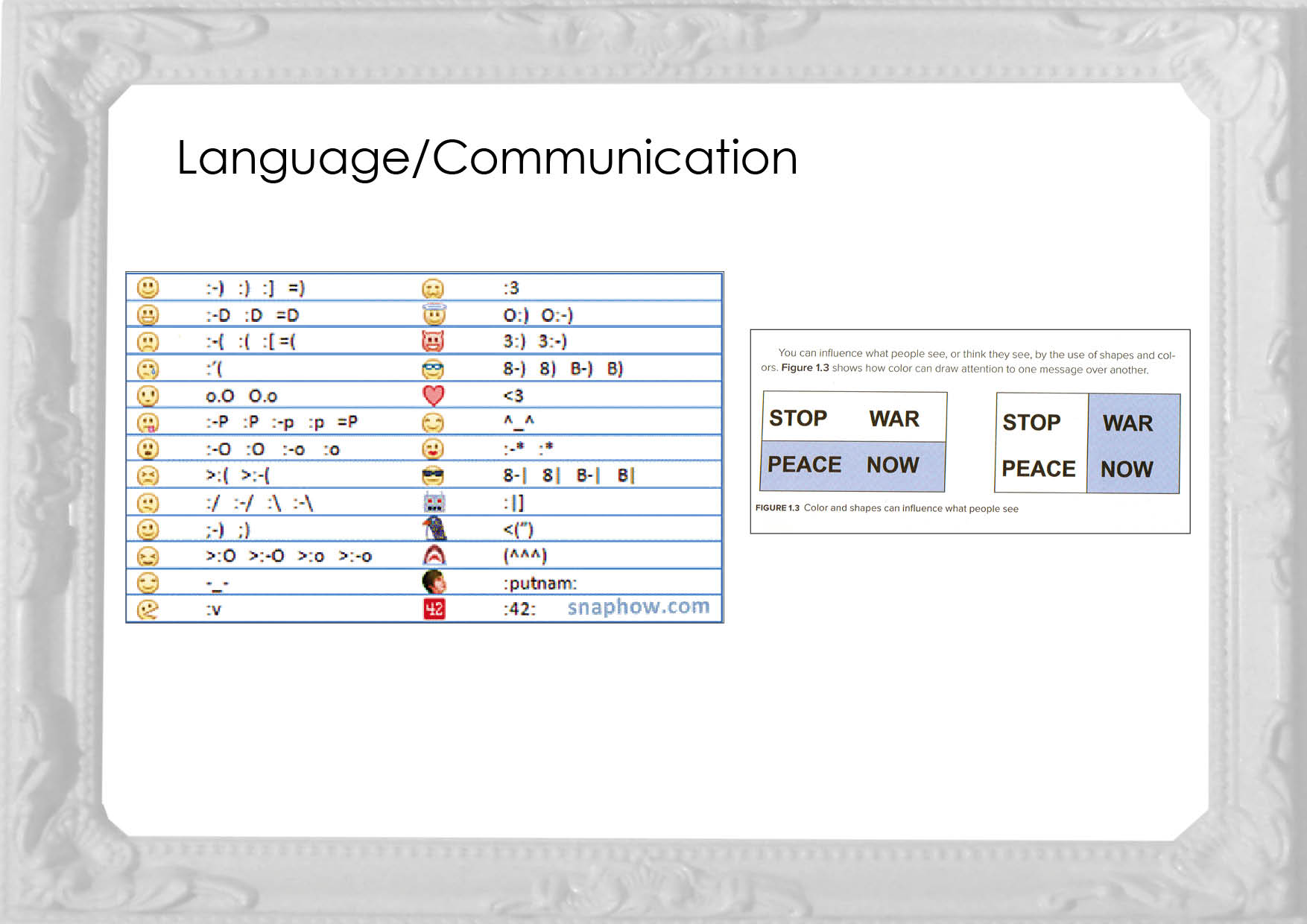
Even the simple layout of text can create a completely different message.
And then lasting is Affective Computing. This is a study and development of devices that recognise and simulate human emotion such as emotional speech, facial expressions and body gesture. This I touched upon earlier and am interested to know if how a person is standing and if they are smiling or sad and so on, actually has an impact on your movements on the web.
——
Having presented this I feel this area has gone well and is a section of something that is a lot bigger. As highlighted to me what I need to do is look at what people are not considering, where there may be a gap and show what people are not considering. I have gather the information for cognitive psychology but now I need to look at how the internet may, or may not changed communication.
Do we treat the internet differently when in fact should it be viewed the same? Afterall the internet was never intended for visual purposes and merely as a resource of information/library. Is an advertisement in a magazine for example any different to an image online and how you look at it any different?
I need to look at the development of the internet and communication. Gaining a deeper understanding of how we interpret the internet.
Who decides what we see and how we still have the same visuals regardless…do we see it differently? Are the theories of the past being forgotten and swamped by the internet and to so called, new way of thinking?
In the research I have done do they take a look at imagery and how the imagery alone can engage someone? Or is it all based on cognitive psychology? Without considering the image that sits before us?
I have this wealth of information on cognitive psychology. Now I need to see if these people take in to account the power of the image alone, ignoring all the details of the buttons and placement and focus on the engagement of the image.
Actions following this:
Research…
