Component 2: The Literature Review
Introduction
The significance of my practice is looking at how design has changed over time to share information and to understand user interaction and experience. The World Wide Web and the designers’ focus has shifted to look closely at these areas in design which are beginning to be seen as key points on how the web is to develop to influence and persuade the user, and in doing so making it a place for all, completely accessible regardless of location and ability.
What is important nowadays when designing for the web? Is it colours, placement, imagery, the user? In this study I shall focus on, debate and analyse the texts, to discuss the answer to such questions, within the key areas of history of graphic design and how its conventions, considerations and goals have adjusted over the years, visual culture and the art of seeing and interpreting, Human Computer Interaction (HCI) and the workings of the mind and visual perception encompassed within Cognitive Psychology focusing on the Gestalt Theory – persuasion, proximity and similarity.
It is the relevance of these theories and how much they stand true when used within the present day environment of the Internet that shall be the focal point of my full Masters study.
History of Design + the Internet
When considering the history of design it becomes clear changes have taken place to accommodate advances in technology. Traditional design was about making the subject matter visually attractive and eye catching. Now, in addition, design on the web is to inform and communicate, and in doing so make the context simple and as understandable as possible.
Hollis (2001) looks right back to the 1970s where Graphic Design was mainly used by business owners, looking for an innovative way for their advertisements to stand out from the crowd. With this decade being extremely important in terms of significant advancements in technology, doors began to open in the world of design, providing new possibilities and opportunities.
As technology advanced the production process became faster and more efficient with the ability to cut and paste at a click of the button as opposed to conventional design when mistakes could cost time and money. The role of the designer diminished as the computer appeared to do it all and Drucker and McVarish (2009) reflect on the artist Sol Lewitt’s bold claim that “…the machine makes the art” (p.325). This caused some concern for designers and the changes taking place constantly met with uncertainty, whilst according to Meggs (1998, p457) “…others embraced it…capable of expanding the scope of design.”
As I look at how design has changed over time, following the influence of technology, and consider how we approach the design of the web to influence and create trust for the user, Drucker and McVarish (2009) have a significant impact on my study by referencing how graphic design has now become more than communication of the image – it is about the positioning and sharing of information as graphic design is now often referred to as information design. It has developed to consider the building of information and user scenarios “…interactivity itself soon became a focus of design, a focus that required attention to user scenarios and behaviors” (p.329). They continue to discuss this further suggesting that the goal for the designer is to break down the interaction process in to bite size parts.
With graphic design being the traditional method of design prior to the Internet, in my own professional experience and those of colleagues web designers often came from a graphic design/print background then moved over to web and digital based work. This allowed for the style to be carried over to the Internet. Was this really working for the digital environment? It would explain the need for this pause and time to understand the theories of interaction to determine if this environment needs to be looked upon differently.
The World Wide Web (WWW) demonstrates how important participation is in postmodern culture where the focus of the piece is on participation, process and experimentation by building familiarity with elements of real life placed within the digital environment. Such examples being the magnifying glass to search, or a folder to store files on, these references build familiarity and aid the interaction of the user, but are adjusted to suit the environment they are placed in. Although technology continues to advance, as Meggs (1998) describes, “…the essence of graphic design remains unchanged.” (p.475). This essence that Meggs discusses suggests that despite the increased need for a focus on user scenarios and behaviour to achieve this the designer simply needs to redefine the concepts in innovative visual ways to accommodate for this new generation of users. For example the bin icon on the computer once emptied cannot be retrieved, or filing a second document of the same name will replace the original, the role of the designer needs to shift to consider the familiar and expectations of the user and interaction on the web differs to that in real life.
Visual Culture.
Everything we see and do is visual; our personal viewpoint, experiences colour our interpretation of what we see, no matter the original intention of the designer. With this in mind and my interpretation of the theories of Mirzoeff (1999, 2002, 2009), Hall (1997) and Drucker (1994, 2004) my understanding is that the visual experience is purely an individual one.
As discussed by Nicholas Mirzoeff (1999, 2002, 2009), visual signs and images are not absolute, it is the meaning, and interpreting and understanding that takes place in society that develop their symbolic function and meaning. What we have grown to know in society and how society has decided what a particular image represents. For example, a red button means OFF or STOP and a green button means ON or START. But surely it is the surroundings that define the button’s meaning…we know the television is off because no picture is showing, no sound is being created and if we were to change the colour or the function we would still know whether it is on or off. Hall (1997) discusses this further in his text. ”Colours do not have any ‘true’ or fixed meanings…Red does not mean ‘Stop’ in nature, anymore than Green means ‘Go’.” (p.26). Therefore my understanding is that the setting of the piece symbolises its meaning and hence influences how the user should interact.
Words, sounds and images are used to express meaning and communicate thoughts to other people, what we must remember is this meaning is known to us because of our previous experience, our social/cultural settings and the environment in which we are raised. My definition of Hall’s (1997) concept is that meaning can never be fixed if culture can change what things mean and how they are interpreted. To understand this difference between cultures we need to include ethical considerations – for example some Asian and Arabic countries read from right to left as opposed to the Western norm of left to right; I propose that this would have an impact on how the user interacts with the user interface. Fig 1.1 and 1.2 show an example of how design considerations completely change when in a different culture. Figure 1.2 shows how the Arabic BBC news website is a complete mirror image of the UK one in Figure 1.1. The logo sits on the right and the search on the left for Arabic news, taking into account the direction of reading.
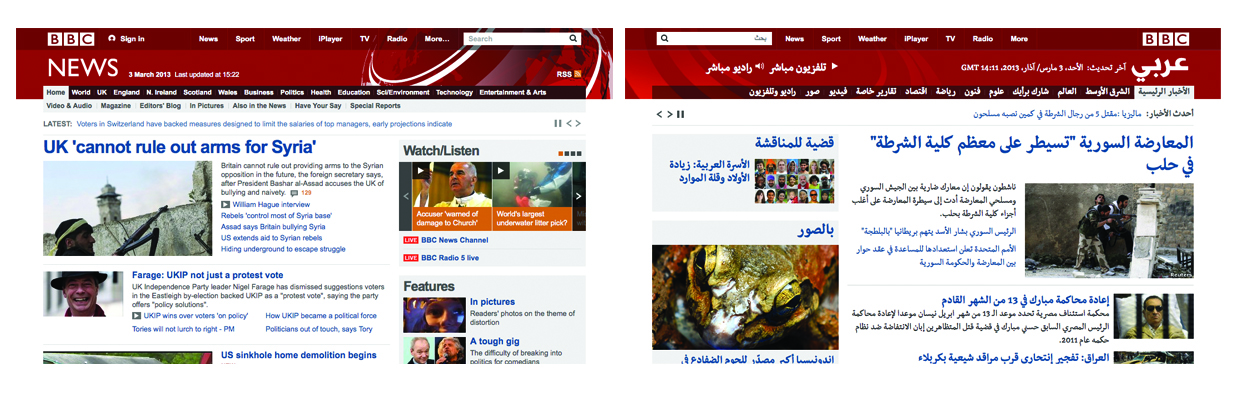
(Left) Figure 1.1. BBC News UK
(Right) Figure 1.2. BBC News Arabic
This brings in the theory of sequence as discussed by Drucker (1994, 2004) as a way to present information. She explains that, “…sequence is designed as a system of order rather than to promote linear movement – sequence participates in the distribution of elements into an organized systems where location helps provide access.” (p.258). This method is key to my thinking and practice as an approach to influence and engage the user through a predefined route to a desired goal.
In society we have control of meanings and interpretation and we can collectively create new signs, new meanings by representation, Hall (1997, p23-24) explains, ”…we can all ‘agree’ to allow words to carry somewhat different meanings…” Words and terminology are constantly being added to the Oxford English Dictionary and many of these are from the influence of technology advancements. To illustrate this, recent additions to the Oxford Dictionaries Online (2013) show how technology truly is setting the pace in how we communicate in todays generation with words such as, “…gossip mill, friend zone, tweetable, and social sharing…touchless all included.” It is we in society who decides on these terms through the meaning and interpretation we exchange with each other.
As visual culture highlights, we can essentially influence the meaning of something by the way designers design and present it. This would imply that with the representation of an object in a familiar setting whereby there is some pre-existing meaning we could adapt it to change the conditioning we have had from society that we have grown up in. This would justify that the action of pressing a button and then transitioning to a swipe action, when placed in the right setting can be a smooth and successful process creating a whole new meaning and sign.
Combined Cognitive Psychology and User Experience Studies
When considering the influence of design with regards to the user behaviour I shall look at theories within cognitive psychology to understand human behaviour and visual perception as a basis for my studies of behaviours on the web. The Gestalt Theory, detailed later, focuses on the representation of objects and how this can influence the on looker.
As Davis (2005) explains, “we don’t just sit in a corner mentally processing things without reference to the effects of social, emotional and organizational context,” (p.2) hence why HCI is such a focus in present times for computer scientists, psychologists and designers. She continues interestingly, to highlight that when a computer responds to our requests, requirements and searches it forms a resemblance to real human-like intelligence, which impresses us and increases our trust in the device.
“Studies have shown that low self-efficiency for computing activity predicts people’s avoidance of it, and performance when doing it, more strongly than gender, age, training, or even expectations of whether it’ll work,” (p.30) identifies Davis (2005).
Gleitman, Rozin and Sabini (1997) note that Solomon Asch was an influential American Psychologist (1907-1996) who was known for his focus on order and understanding not from the situation but from how it is noticed through conformity and persuasion, which has great relevance in todays’ world with reviews having great influence on peoples’ actions and opinions on the web. They continue to discuss Asch’s study to show that “…people are ultimately independent” (p.984). In fact he found the opposite and found given a series of lines and a set of participants who gave wrong answers still there remained to be a significant amount of conforming – in fact the majority conformed to the wrong answer despite knowing it was incorrect.
Following on from the Gleitman et al studies of Asch I analyse this to suggest that the influence of the majority would have a key impact in the decisions people make. In light of this I would be interested in using this within my practice as reviews of products becoming a leading form of persuasion and influence on the web, therefore testing if popularity ratings can govern the decisions made.
As we begin to understand HCI in more depth, the psychology of the Internet can be often overlooked because as Davies (2005) explains, psychologists begin to question if we can truly predict how people will interact with the web when “…each individual is assumed to be governed by a completely unique internal ‘world’.” (p. 44).
This idea features heavily in the work of Susan M Weinschenk (2011), a key psychologist who focuses her practice on the design of technology. It is here I question the authenticity of her findings as she heavily references past experiments to understand human behaviour on the web yet these without them being in the context which she discusses. She investigates the Kanizsa rectangle within the Gestalt movement, shown in figure 1.3, in relation to how the brain creates shortcuts of what it sees. This led to her idea that designers can “…influence what people see or think they see by the shapes and colors.” (p. 2). A similar theory is that known as the Framing Effect discussed by Bradley (2010) in the context of how this concept can influence the user. The belief is that frames, or borders, draw in and contain the onlooker and lead them down a predefined route (Figure 1.4), very much like the Kanizsas Rectangle as discussed by Weinschenk (2011).

Figure 1.3. Example of Kanizsa Rectangle

Figure 1.4. The Framing Effect
Weinschenk (2011) and Gordan (1989) discuss the area of proximity, similarity and grouping within the area of the Gestalt theory. They believed in the relationship between the world and everyday experience, something featured heavily in the design of the web today and a focus for my study.
As with Asch’s area of conformity, Gestalt theorists investigated conditioning as mentioned by Ian E Gordan (1989), ”…when a chicken was trained to peck at the darker of two greys and this is now paired with an even darker grey, it is to the latter the animal now responds – suggesting that the original learning involved a relationship rather than an absolute stimuli.” Investigations also took place with monkeys, showing that “monkeys solving problems which are more related to their natural lives than the laboratory…do not engage in constant trial and error, but show periods of inactivity followed by sudden solutions of the problems.” (p.57).
If this were true for animal behaviour then it would be reasonable to think that humans react in similar ways. This would suggest that over time we become conditioned to know how to respond. As technology advances and how we interact with it changes we can hardly recollect the shift as we have adjusted with ease from pressing buttons to swiping to achieve the desired goal. But having discussed visual culture earlier to what extent is this true? Weinschenk (2011) continues to discuss the concept of “…red means ‘in the red’ or financial trouble, or it could mean danger or stop. Green means money or ‘go’.” (p.27). She suggests choosing colours carefully with these meanings in mind, contradicting the views of Hall (1997) who believed that colours have no predetermined meaning. In light of this it would be fair to also consider the context as this dictates the meaning as well as the arrangement, organization when designing.
Conclusion
Potential gains can be realised by understanding the methodologies mentioned above however examining cognitive psychology suggests the experimental timeframe and the time the Internet existed are vastly different. Many professionals are beginning to look towards understanding human behaviour within the digital world, yet in looking forward we have been looking back without taking it and applying it to modern theories to see if it still stands true. HCI has the potential to play a significant role in contributing to the advancement of the web. It is important to understand the needs and filter out the areas we currently become fixated on without solid evidence as to its authenticity.
This investigation has asked if we should be treating the design of the web differently and if so how we can design it to influence and build trust for the audience who use it.
Although I believe HCI for computers is largely misunderstood at present it would be unfair for me to be sure on this statement without proof to justify such claims. This therefore opens up the practice I am undertaking to better understand what people are drawn to in the digital environment pushing forward the innovation of the future of web design.
As discussed within this essay, the experiences people receive are largely unique and to that individual. This would suggest that it is very hard to draw a perfect design that captures everyone’s’ needs from their visit to the web, however focusing on persuasion and influence could lead to significant conformity in actions the user takes. Although there are clear absences in the methodologies mentioned above, the study has revealed insight in to the development of user interaction and theories to be applied to move forward.
List of References:
Bradley, S. (2010). The Framing Effect: Influence Your Audience By Setting The Context. Retrieved from http://www.vanseodesign.com/web-design/framing-expectation-exposure-effect/
Davis, C. (2005). Finding and Knowing. Psychology, Information and Computers. London, United Kingdom: Routledge.
Drucker, J. (1994, 2004). The Book as Sequence: Narrative and Non-Narrative. The Century of Artists’ Books. New York, NY: Granary Books.
Drucker, J., & McVarnish, E. (2009). Digital design after the 1970s. Graphic Design History. A Critical Guide (pp. 323-339). United States of America: Pearson Education.
Gleitman, H., Rozin, P., & Sabini, J. (1997). Solomon E. Asch (1907–1996): Obituary, 52(9), pp. 984-985.
Gordan, I. E. (1989). Theories of Visual Perception. United Kingdom: John Wiley & Sons Ltd.
Hall, S. (1997). Chapter 1. Representation, meaning and language. Representation: Cultural representations and signifying practices (pp.15-29). London, United Kingdom: SAGE/Open University.
Hollis, R. (2001). Graphic Design. A Concise History. (pp.186-223). London, UK: Thames & Hudson Ltd.
Meggs, P. (1998). The Digital Revolution. A History of Graphic Design (pp. 455-475). United States of America: John Wiley & Sons, Inc.
Mirzoeff, N. (1999). Introduction. What is visual culture? An Introduction to Visual Culture. United Kingdom: Routledge.
Mirzoeff, N. (2002). The Visual Culture Reader. (2nd ed.). United Kingdom: Routledge.
Mirzoeff, N. (2009). An Introduction to Visual Culture. (2nd ed.). United Kingdom: Routledge.
Oxford Dictionaries. What’s new? (February 2013). Retrieved from http://oxforddictionaries.com/words/what-s-new
Sturken, M., & Cartwright, L. (2001) The Internet: global village or multinational corporate marketplace? Practices of Looking. An Introduction to Visual Culture. Oxford, NY: Oxford University Press Ltd.
Weinschenk, S. M. (2009). Neuro Web Design. Berkeley, CA: New Riders.
Weinschenk, S. M. (2011). 100 Things Every Designer Needs to Know About People. Berkeley, CA: New Riders.
List of Images:
Figure 1.1. BBC News – UK. Retrieved from http://www.bbc.co.uk/news/
Figure 1.2. BBC News – Arabic. Retrieved from http://www.bbc.co.uk/arabic/
Figure 1.3. Example of a Kanizsa rectangle: Weinschenk, S. M. (2011). 100 Things Every Designer Needs to Know About People. Berkeley, CA: New Riders.
Figure 1.4. The Framing Effect. Bradley, S. (2010). The Framing Effect: Influence Your Audience By Setting The Context. Retrieved from http://www.vanseodesign.com/web-design/framing-expectation-exposure-effect/
Bibliography:
Bradley, S. (2010). The Framing Effect: Influence Your Audience By Setting The Context. Retrieved from http://www.vanseodesign.com/web- design/framing-expectation-exposure-effect/
Behrens, R. R. (1998). Art, Design and Gestalt Theory. Leonardo 31(4), 299-303
Bonnici, P. (1999). Visual Language. The Hidden Medium of Communication. Switzerland: RotoVision SA.
Davis, C. (2005). Finding and Knowing. Psychology, Information and Computers. London, United Kingdom: Routledge.
Drucker, J. (1994, 2004). The Book as Sequence: Narrative and Non-Narrative. The Century of Artists’ Books. New York, NY: Granary Books.
Drucker, J., & McVarnish, E. (2009). Digital design after the 1970s. Graphic Design History. A Critical Guide (pp. 323-339). United States of America: Pearson Education.
Gleitman, H., Rozin, P., & Sabini, J. (1997). Solomon E. Asch (1907–1996): Obituary, 52(9), pp. 984-985.
Gordan, I. E. (1989). Theories of Visual Perception. United Kingdom: John Wiley & Sons Ltd.
Hall, S. (1997). Chapter 1. Representation, meaning and language. Representation: Cultural representations and signifying practices (pp.15-29). London, United Kingdom: SAGE/Open University.
Hollis, R. (2001). Graphic Design. A Concise History. (pp.186-223). London, UK: Thames & Hudson Ltd.
Joinson, A. N. (2003). Understanding the Psychology of Internet Behaviour. Virtual Worlds, Real Lives. Basingstoke, UK: Palgrave Macmillan.
Krugg, S. (2006). Don’t Make Me Think! A Common Sense Approach to Web Usability, Second Edition. United States of America: New Riders.
Lindgaard, G., Fernandes, G., Dudek, C., & Brown, J. (2006). Attention web designers: You have 50 milliseconds to make a good first impression! Behaviour and Information Technology, 25(2), pp. 115-126.
McCloud, S. (1993). Understanding Comics. The Invisible Art by Scott McCloud. United States of America: HarperCollins Publishers, Inc.
Meggs, P. (1998). The Digital Revolution. A History of Graphic Design (pp. 455-475). United States of America: John Wiley & Sons, Inc.
Mirzoeff, N. (1999). Introduction. What is visual culture? An Introduction to Visual Culture. United Kingdom: Routledge.
Mirzoeff, N. (2002). The Visual Culture Reader. (2nd ed.). United Kingdom: Routledge.
Mirzoeff, N. (2009). An Introduction to Visual Culture. (2nd ed.). United Kingdom: Routledge.
Moggridge, B. (2007). Designing Interactions. United States of America: MIT Press.
Oh, H., & Price, J. (2012). How do storefront window displays influence entering decisions of clothing stores? Journal of Retailing and Consumer Services 19(1), pp. 27-35.
Oxford Dictionaries. What’s new? (February 2013). Retrieved from http://oxforddictionaries.com/words/what-s-new
Rock, I. (1990). The Legacy of Solomon Asch: Essays in Cognition and Social Psychology. Hillsdale NJ: Psychology Press.
Sturken, M., & Cartwright, L. (2001) The Internet: global village or multinational corporate marketplace? Practices of Looking. An Introduction to Visual Culture. Oxford, NY: Oxford University Press Ltd.
Wallace, P. (1999). The Psychology of the Internet. Cambridge, UK: Cambridge University Press.
Weinschenk, S. M. (2009). Neuro Web Design. Berkeley, CA: New Riders.
Weinschenk, S. M. (2011). 100 Things Every Designer Needs to Know About People. Berkeley, CA: New Riders.
